
Return-to-Office vs. Hybrid: What the Ontario Data Actually Says
Written by: The H2R Team
Are you one of many Ontario SMBs considering return-to-office? Since the global pandemic, hybrid work arrangements have become the norm, but sentiments are changing. Some business owners are seeing return-to-office as an opportunity to increase productivity, promote accountability, and build a stronger office culture.
This article looks at what recent Canadian data says about return-to-office (RTO) versus hybrid work, why some organizations are pulling back toward in-office mandates, and how to figure out whether your hybrid setup is genuinely broken or just poorly managed.
Table of Contents

Why Return-to-Office Is Coming Back
Several large public-sector and private organizations in Ontario have walked back flexible arrangements over the past two years, and it’s pushed a lot of smaller employers to second-guess their own policies.
The Ontario Government’s Return-to-Office
The provincial and federal public service have both moved toward stricter in-office requirements, with departments setting minimum in-office days and tightening enforcement of existing hybrid policies.
When the government and large employers make headlines with RTO mandates, smaller businesses start wondering whether they should follow suit.
Common Reasons Organizations Push for RTO
- Collaboration concerns: Leadership feels spontaneous problem-solving and mentorship happen more naturally in person.
- Culture and visibility: A belief that being seen working builds trust and cohesion.
- Real estate sunk costs: Office leases that are already paid for and sitting half-empty.
- Management discomfort with remote oversight: Some managers simply find it harder to assess performance without seeing employees physically.
- Onboarding and training friction: Managers think that junior employees need more in-person support compared to senior staff.

Return-to-Office vs. Hybrid: What the Ontario Data Actually Shows
To get to the bottom of the return-to-office vs. hybrid debate, we took a look at what data is available to demonstrate how employees feel about hybrid work, return-to-office mandates, productivity, and what influences retention.
For a quick idea of the results, there’s no clear winner between return-to-office and hybrid work. The data shows a workforce that’s genuinely split, with real tradeoffs on both sides.
Hybrid Is Preferred Over Remote or In-Person
A recent Indeed survey found that most Canadian employees prefer a hybrid approach — 80% prefer some in-office time, and only one in five favour fully remote work. That means that full remote isn’t actually what most people are asking for, most want a balance.
But the same survey found that rigid RTO policies carry real costs. Nearly nine in 10 respondents reported at least one challenge tied to in-office work. These challenges include reduced time for personal or family responsibilities, less schedule flexibility, sleep disruption, and increased feelings of burnout.
Only 9% of Canadians Prefer On-Site Work
Three-in-five Canadians (59%) say they’d prefer to spend the majority of their working time at home if it were possible, and seven-in-10 (68%) say they’d rather work from home most of the time. Just nine per cent show a preference for full-time, on-site work.
Return-to-Office May Affect Retention
One of the biggest risks related to return-to-office mandates is retention. Only 20 per cent of respondents said they’d feel positive about an increase in required office days, while nearly one in five said they’d consider looking for another job.
What Happens When Employees Are Actually Asked to Return
- Of those asked to come back, 72% followed the policy. Five per cent quit. And about one-quarter agreed to the request but admit they regularly spend fewer days in office than required.
- Of the employees who did return, roughly half carried some level of resentment into the office. About a quarter described themselves as “very upset,” another quarter as “upset,” and only 17 per cent were actually pleased about it.
The Productivity Perception Gap
More than half of Canadians under 65 (57%) believe workers are just as productive or more productive working from home. Among those who’ve actually experienced remote work, that number climbs to 73%.
This is an important statistic for employers who still question how productive their team is outside the office. If your employees genuinely believe they do their best work at home, but you require them back without addressing that directly, you may end up disrupting retention and trust.
What Employees Are Actually Trying to Protect
When people push back on RTO, they’re usually protecting something specific.
The data says that 8% of working-age Canadians cite avoiding the commute as the top benefit of remote work, followed by improved mental health (49%). For parents, savings on childcare are also a major benefit. About 27% of those with kids at home name savings on childcare as a direct benefit of remote work.
The Equity Dimension
Broader polling shows Canadian workers are close to evenly split: roughly 45-57% support some mandated office time, while the other half oppose full returns. Younger employees, women, and those with WFH experience are consistently more opposed to strict RTO policies.
This matters for Ontario employers from both a retention and an equity standpoint. Women and younger workers disproportionately benefited from remote work flexibility — for caregiving, for cost savings, for schedule control. A blanket RTO mandate without accommodations may hit those groups harder than others.
Return-to-Office vs. Hybrid: Data Summary
| What the Data Shows | What It Means for Employers |
|---|---|
| 80% of employees prefer some in-office time. | Full remote isn't what most people are asking for. |
| Nearly 9 in 10 report real challenges with office work. | Mandates without flexibility carry measurable retention risk. |
| 1 in 4 returners quietly ignore the policy. | Compliance isn't the same as buy-in. |
| Women and younger workers are more opposed to strict mandates. | Blanket policies may create equity issues that are difficult to reverse. |
| 73% of remote-experienced workers believe working from home is equally productive. | Productivity arguments for return-to-office are a harder sell than many leaders expect. |
The Data Doesn’t Mean Hybrid Is Perfect
While much of the data shows that employees value, and often prefer, hybrid work arrangements, that doesn’t mean hybrid is perfect. Like return-to-office, hybrid also has its own challenges and trade-offs to consider:
- New hires struggling to build relationships with people they rarely see in person
- Mentorship and informal knowledge transfer happening less frequently
- Meetings that drag because half the room is on a screen and half is present
- Managers who never adjusted their leadership style for distributed teams, so they default to either total hands-off or excessive check-ins
The key distinction: Hybrid work itself isn’t the problem, it’s a matter of better management and processes. A hybrid policy that was thrown together in 2021 and never revisited is going to produce worse outcomes than one that’s been deliberately designed, communicated, and maintained.

The Real Question: Is Hybrid Failing, or Is the Policy Failing?
Before assuming hybrid doesn’t work for your business, it’s worth checking whether the policy — or how it’s being managed — is actually the issue.
Signs the Policy or Strategy Is Failing
- There’s no clear expectation for which days people should be in office, or it changes constantly
- In-office days aren’t coordinated, so employees come in and find nobody else is there
- Managers haven’t been trained on how to run hybrid teams, set goals remotely, or give feedback without daily in-person contact
- Performance issues are being blamed on remote work without any data that actually connects the two
- There’s no clear reason for office days beyond “it feels right”, there’s no tie to collaboration, training, or client-facing work
This is why a lot of Ontario SMBs get stuck. They don’t have the internal HR capacity to build a hybrid policy properly, train managers on leading distributed teams, or diagnose whether a performance dip is a hybrid issue or something else entirely.
A fractional HR consultant is someone who can simplify this process and close that gap. They build the policy, support the manager training, and step back once the structure is working smoothly.
Not sure whether your hybrid approach is working? H2R works with Ontario SMBs to assess what’s driving hybrid friction and build policies that actually fit how the business operates. Book a consultation.
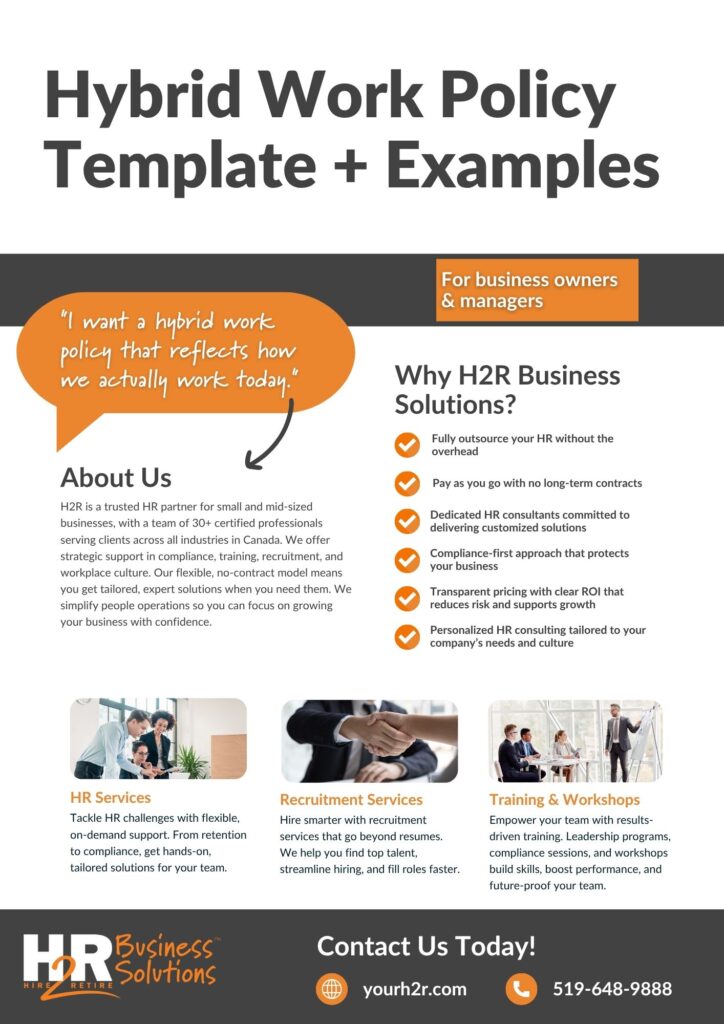
Free Download: Hybrid Work Policy Template + Examples
H2R’s Hybrid Work Policy Template gives Ontario employers a practical, ready-to-use foundation that you can adapt to your team size, structure, and culture. It’s not a generic fill-in-the-blank document. It’s built around the problems Ontario SMBs actually run into: unclear expectations, uncoordinated office days, managers who don’t know what they’re supposed to enforce, and employees who aren’t sure what the rules actually are.
What’s inside:
- A complete hybrid work policy framework written for Ontario employers, covering eligibility, scheduling expectations, performance standards, and manager responsibilities
- Real before-and-after policy language showing the difference between vague hybrid rules and ones that actually hold up
- Examples of how to define in-office day requirements in a way that’s tied to work purpose
- Guidance on how to communicate a policy change without triggering the resentment that comes with a surprise mandate
- A manager expectations section you can plug directly into your existing onboarding or training materials
Fill out this form to download our Hybrid Work Policy Template
Frequently Asked Questions
Are hybrid employees less productive?
Not according to the available data. Most Canadians, especially those with remote work experience, believe productivity at home is equal to or better than in-office work. Where productivity problems do exist in hybrid teams, they’re more often tied to unclear expectations or managers who haven’t adapted their approach to hybrid arrangements.
Why are organizations bringing employees back to the office?
Many organizations are implementing a return-to-office mandate because they want more in-person collaboration, existing office leases are going unused, and remote performance is harder to assess.
Does hybrid work improve retention?
It can, particularly for employees who rely on that flexibility for commuting, family responsibilities, or schedule control. Canadian surveys show a meaningful share of employees would consider leaving a job that increases mandatory in-office days without offering flexibility in return.
What are the biggest challenges of hybrid work?
The most common ones are weaker onboarding and mentorship for new hires, poorly coordinated in-office days, and managers who haven’t adjusted their leadership approach for a partly remote team.
How can SMBs make hybrid work more effective?
Start with a clear, written policy that ties office days to a specific purpose. Train managers on setting expectations and measuring output rather than presence. Review the policy at least annually and update it when the business changes.
Should managers receive hybrid leadership training?
Yes. Most hybrid breakdowns trace back to management practices that were never updated for distributed teams. Training managers on hybrid leadership is usually a faster and more cost-effective fix than rolling out a full RTO mandate.
Enjoyed this article? Share this post!
Follow H2R on Social