
Is Your Hybrid Work Policy Outdated? Here's How to Audit & Fix It.
Written by: The H2R Team
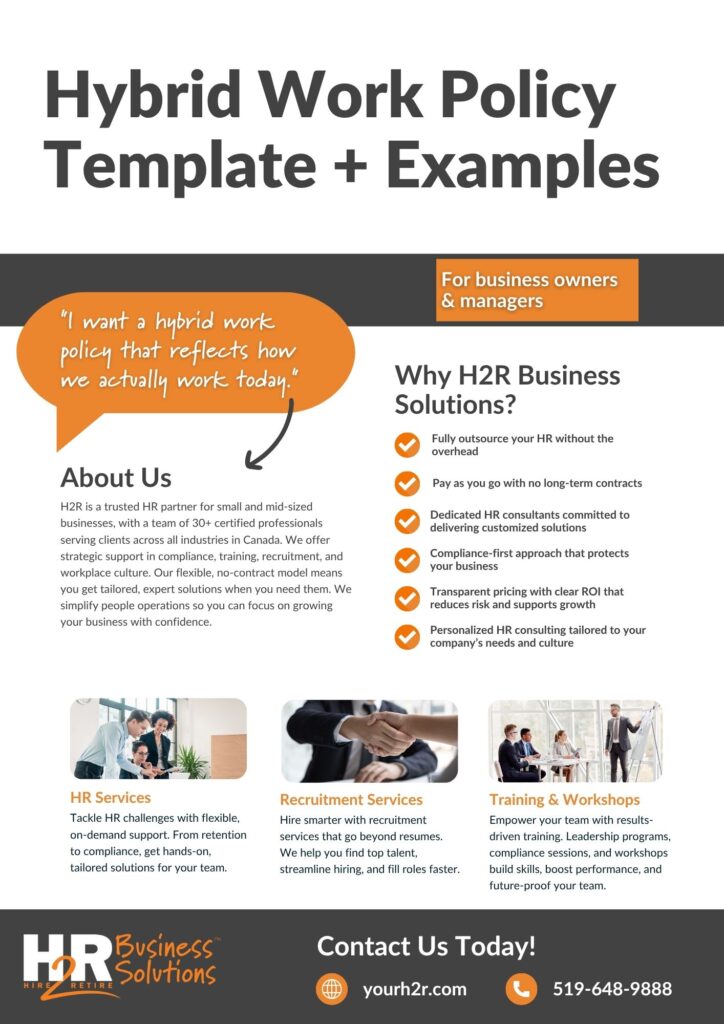
Free Download: Hybrid Work Policy Template + Examples
Is Your Hybrid Work Policy Missing Critical Clauses?
Most outdated hybrid policies didn’t start out badly written, they just never had a solid framework to begin with, so gaps got patched slowly as questions came up.
Download our Hybrid Work Policy Template and identify the gaps before they become problems.
What’s Included
The template covers the areas that commonly create confusion in Ontario workplaces:
- In-office attendance requirements and business justification
- Availability and communication standards
- Remote work equipment and expense responsibilities
- Exception and approval processes
- AI usage and data security expectations
- Accommodation language aligned with Ontario human rights requirements
- Manager responsibilities and enforcement guidelines
The best time to update a hybrid work policy is before someone challenges it.
Download the template, compare it against your current policy, and see where expectations, procedures, and responsibilities may be unclear.
Table of Contents

Download Our Hybrid Work Policy Template + Examples for Free
Build a clear, fair, and flexible policy your team will actually follow.
Fill out this form to download our Hybrid Work Policy Template
If your hybrid work policy was written in 2021 or 2022, there’s a good chance it no longer matches how your team actually works.
We see this constantly with Ontario employers: the policy on paper says one thing, the reality in the office says another, and nobody knows what to enforce. This leads to inconsistency, frustration, and confusion.
This article walks through how and why hybrid work policies don’t get updated. We’ll go over the warning signs and a practical process for auditing and updating yours.
How Hybrid Work Policies Become Outdated
- They were built for a different moment. Many hybrid work policies were written quickly during the return-to-office scramble. After being entirely remote, businesses were desperate to get people back in the building a few days a week. As a result, most policies were rushed and not designed around actual business needs.
- Enforcement drifted overtime. The policy says three in-office days are mandatory, but nobody’s tracking attendance, and some are actually in-office only twice a week. The policy becomes whatever people want it to be, which really just means you’ve got a document with no authority.
- The team has changed. New hires were onboarded under an informal version of “how things work here,” not the original policy. Promotions have shifted who manages whom. The original policy may reference a team structure or office layout that doesn’t exist anymore.
- Tools and work patterns evolved. Project management software, AI-assisted writing and research tools, and async communication norms have changed what being available vs. being productive looks like. A policy focused purely on being in the office misses most of these, which determines whether hybrid work is functioning well.
- Legal and competitive context shifted. Ontario’s labour market has tightened and loosened repeatedly since 2022, and candidate expectations around flexibility have shifted with it. A policy that made sense when you had your pick of applicants might be working against you now.

Signs Your Hybrid Work Policy Needs an Update
- Managers enforce the policy differently. One team lead insists on three in-office days; another lets people self-manage entirely. Employees notice, and it breeds resentment across the organization.
- New hires ask questions the policy doesn’t answer. “Do I need approval to work from a coffee shop?” “What happens if I move out of commuting distance?” If you’re answering these in Slack messages, the policy isn’t doing its job.
- Office attendance and policy requirements don’t match. Attendance shows people aren’t coming in on the days the policy requires, but nothing happens when they don’t.
- Productivity conversations keep stalling. Performance reviews mention “availability” or “presence” in vague terms because there’s no actual standard to measure against.
- The policy doesn’t mention AI tools, async work, or current collaboration platforms. If your policy was written before generative AI tools were part of daily work, it’s missing a piece that affects how work actually gets done now.
- Exceptions have become the rule. If most of your team has an informal exception to the standard policy, the standard policy isn’t really a policy anymore.
- You’ve had a turnover spike or exit interview pattern pointing to flexibility. When candidates or departing employees consistently bring up rigid in-office requirements, that’s a clear sign something is wrong.
If two or more of these apply to you, it’s worth a proper audit.
What If I Have No Hybrid Work Policy?
Technically, a formal hybrid work policy isn’t legally-required. However, it is an important tool to structure hybrid work, clarify expectations, and standardize enforcement of hybrid work rules.
The biggest risk of operating a hybrid workforce without a policy is inconsistency.
Without a written policy:
- Managers make different calls for similar situations, which can look like favouritism even when it isn’t intentional.
- New hires have no reference point and rely on whatever their manager happens to tell them.
- You have limited ground to stand on if a workplace conflict, accommodation request, or performance issue ends up needing documentation.
- It’s harder to set expectations during recruitment, which can lead to mismatched expectations after someone’s hired.
How to Audit and Update Your Hybrid Work Policy (Step-by-Step)
Step 1: Review Your Current Policy
Start by reviewing your existing hybrid work policy line by line. Compare what’s written to how your team actually works today.
Look for outdated requirements, unclear expectations, and missing topics such as AI use, remote work outside Ontario or Canada, data security, and exception requests. Any gap between policy and practice is a sign the document needs updating.
Step 2: Gather Employee Feedback
Before making changes, collect feedback from employees. A short anonymous survey can help identify common frustrations, unclear expectations, and support gaps. Ask about hybrid schedules, communication standards, remote work resources, and overall satisfaction with current hybrid work arrangements.
Step 3: Identify What Is and Isn’t Working
Review performance data, project outcomes, and employee feedback to determine whether problems are truly related to hybrid work. Focus on measurable issues, not assumptions. This step helps ensure policy updates address real operational challenges instead of personal preferences.
Step 4: Update the Policy With Clear Expectations
Rewrite vague statements into specific, measurable standards. Clearly define office attendance requirements, work hours, availability expectations, AI usage guidelines, equipment responsibilities, remote work location restrictions, and the process for requesting exceptions. The more specific the policy, the easier it is to apply consistently.
Step 5: Train Managers on Hybrid Team Management
Managers play a major role in policy success. Provide guidance on setting expectations, managing remote and in-office employees fairly, measuring performance based on results, and handling exception requests consistently across teams.

How Often Should You Review Your Hybrid Work Policy?
Generally, for a small to mid-sized business, you should review your hybrid work policy once a year. Regular reviews help ensure the policy remains aligned with business needs and workplace realities.
Each review should answer the question: has anything in the business changed enough that the policy no longer fits? If not, confirm it and move on. If yes, you’re back at Step 1.
Additional reviews may be needed after major business changes such as restructuring, office relocations, new technology adoption, or significant employee feedback.
Frequently Asked Questions
Is a hybrid work policy legally required in Ontario?
No, Ontario employment law doesn’t require a formal hybrid work policy.
That said, we recommend having a written hybrid work policy for most small to mid-sized businesses. It sets clear expectations, gives you something concrete to point to in performance or accommodation discussions, and reduces the risk of inconsistent treatment across your team.
What should a hybrid work policy include?
At minimum:
- In-office day requirements (and the reasoning behind them)
- Availability and communication expectations
- Equipment and expense responsibilities
- A documented exception process
- AI and data-handling guidelines
- A note on accommodation obligations under Ontario’s human rights legislation.
How do you measure productivity in a hybrid workplace?
Most businesses measure productivity through hours logged or visible activity. This may feel like the obvious solution, but it comes off overbearing to employees, which can affect satisfaction and retention.
At H2R, we believe measuring productivity through outcomes is the most balanced approach. This means productivity looks like completed deliverables, reasonable project timelines, and a high quality of work.
Roles with clear deliverables are easier to measure this way; roles built around collaboration or client interaction may need additional qualitative check-ins alongside output metrics.
Should AI usage be included in a hybrid work policy?
Yes. Even a short section covering acceptable AI tool use, review expectations for AI-assisted work, and data confidentiality rules closes a gap that most older policies don’t address at all. This matters more in hybrid settings, where individual employees are making more unsupervised decisions about how they work.
What role does employee feedback play when updating a hybrid work policy?
It’s one of the most reliable ways to find out where the written policy and actual practice have diverged. Employees usually know exactly where the friction points are — communication gaps, unclear expectations, inconsistent manager enforcement — long before that shows up in performance data or turnover numbers.
Enjoyed this article? Share this post!
Follow H2R on Social