
Hire an HR Manager vs. Outsource HR: How to Choose in 2026
Written by: The H2R Team
Free Download: Skills-Based Hiring Toolkit
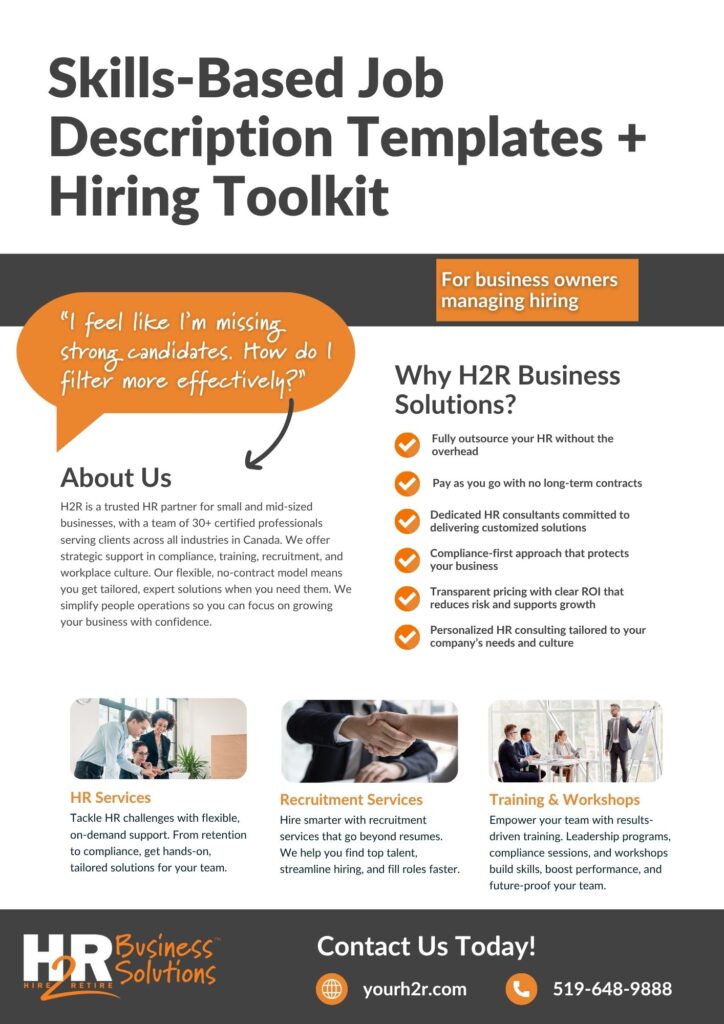
Not sure where to start with skills-based hiring? This free toolkit gives HR teams, hiring managers, and recruiters everything they need to move toward a skills-based hiring approach.
The toolkit includes:
- Skills-based job description examples for four role types
- A skills-based job description template with instructional guidance for any position
- A job description audit checklist to evaluate existing postings
Whether you are updating a single posting or redesigning your full hiring process, this toolkit is built to be customized, shared internally, and put to work immediately.
Table of Contents

Download the Free Skills-Based Hiring Toolkit Today
Write job descriptions that attract stronger candidates and remove unnecessary barriers.
Fill out this form to download our Free Skills-Based Hiring Toolkit
What Is a Skills-Based Job Description?
A skills-based job description focuses on competencies, practical abilities, and measurable responsibilities rather than relying heavily on degrees or years of experience.
Traditional vs. Skills-Based Example
- Traditional: Bachelor’s degree and 7+ years of experience required.
- Skills-based: Ability to manage competing priorities across departments and communicate clearly with stakeholders.
The goal is not to lower standards, but to make sure your requirements actually predict success in the role.
Signs Your Current Job Descriptions May Be Too Restrictive
- “Bachelor’s degree required” for a role where the degree has no bearing on daily performance. If the work doesn’t require knowledge developed specifically through a degree program, requiring one just narrows your talent pool.
- Experience requirements that outpace the role’s actual demands. “10 years of experience” for what would be considered a mid-level position. “5 years experience” with software that’s only been on the market for three. These numbers don’t reflect industry standards and lock out perfectly good candidates.
- Long software competency lists when most tools could be learned on the job. Listing seven specific platforms when the real requirement is comfort with data systems in general. Adaptable candidates who could learn those tools in a few weeks get filtered out before they’re even considered.
- “Nice-to-have” lists longer than the requirements. If your “preferred qualifications” section is more detailed than your “required” section, candidates can’t tell what you actually need.
- Vague buzzwords with no measurable meaning. “Rockstar,” “self-starter,” “dynamic team player,” “go-getter.” These phrases mean something different to everyone and say nothing about what you’re actually looking for.
- Requirements copy-pasted from a posting written five or ten years ago. This happens constantly. The role has evolved, but the description hasn’t. Tasks that were central three years ago may now belong to a different team entirely.
- Industry-specific background requirements for roles where adjacent experience transfers well. Requiring “5+ years in financial services” for a project manager role where the core competency is project management, not financial services expertise.
How H2R Business Solutions Can Help
Many organizations want to modernize their hiring process but don’t know where to start, especially when business owners run their own HR or the HR team is small.
H2R Business Solutions helps small-to-medium businesses:
- Rewrite job descriptions using skills-based hiring principles
- Improve recruitment processes and candidate quality
- Build more effective interview and evaluation frameworks
- Support hiring strategy through fractional HR services
For smaller businesses without a full internal HR department, fractional HR support can provide practical hiring guidance without the cost of building a full in-house team.
Get Flexible HR Support That Works in Your Budget

How to Write a Skills-Based Job Description
Step 1: Start With Outcomes, Not Credentials
Before writing a single requirement, ask yourself: what does success look like in this role at 90 days? In one year?
The answers to those questions should drive the posting, not the credentials of whoever held the role last time.
- Instead of: “Must have an MBA and 10+ years of experience.”
- Use: “Ability to manage multi-department budgets and lead cross-functional projects through to completion.”
Step 2: Separate Required Skills From Preferred Skills
Long lists of requirements discourage potential applicants, who are less likely to apply unless they meet most or all listed criteria.
Structure your posting clearly and honestly:
- Required skills: What someone genuinely needs to perform the role from day one (or close to it). If they don’t have it, you won’t make an offer.
- Preferred skills: What would be a bonus but can reasonably be learned or developed. If they don’t have it, you’d still consider them.
Step 3: Use Measurable Skill Language
Vague language creates confusion and attracts the wrong applicants. Replace generic phrases with language that describes what the skill actually looks like on the job.
| Vague | Measurable |
|---|---|
| "Excellent communication skills" | "Ability to explain technical issues clearly to non-technical clients, including in writing" |
| "Strong organizational skills" | "Experience managing multiple concurrent projects with competing deadlines" |
| "Self-starter" | "Comfortable working independently and identifying when to escalate blockers without prompting" |
| "Rockstar" / "Guru" | Just describe the actual skill |
Step 4: Remove Degree Requirements That Aren’t Genuinely Necessary
For many roles, equivalent experience, relevant certifications, portfolios, or demonstrated competencies are just as valid as a degree. In this case, you shouldn’t make degrees a requirement because it rules out a good portion of the available talent pool.
Where a degree isn’t legally or operationally required, consider replacing it with language like:
- “Or equivalent professional experience”
- “Relevant certification(s) considered”
- “Portfolio or work samples accepted in lieu of formal credentials”
When to keep the degree requirement:
- Regulated professions
- Roles with specific licensing requirements
- Positions where the credential itself is part of the professional standard
Step 5: Prioritize Core Competencies Over Software Wish Lists
A long list of specific platforms often filters out adaptable candidates who understand how to use comparable tools or who could learn those tools in a few weeks. It’s not that you need to avoid mentioning specific tools, but use them as context instead of gatekeepers and/or keep them as a nice-to-have.
- Instead of: “Must have experience with Salesforce, HubSpot, Marketo, Pardot, and Zoho.”
- Use: “Experience with CRM platforms; familiarity with Salesforce or HubSpot is an asset.”
Step 6: Make Responsibilities Reflect the Actual Role
If your responsibilities list has twelve items equally weighted, candidates can’t tell what the role is really about. Over time, old responsibilities stay in the posting, new ones get added, and eventually the description no longer reflects what the job actually involves today.
Before finalizing, do a quick internal check:
- Talk to the person currently in the role. What takes up most of their time?
- Talk to their manager. What genuinely drives performance in this position?
- Remove responsibilities that belong to a different role or a previous version of this one.
- Make sure the top three to five items reflect where the majority of time is actually spent.
Step 7: Include Growth and Development Opportunities
Candidates drawn to skills-based roles care about where they can go, not just where they’re starting. If your organization offers training, mentorship, internal mobility, or structured development, say so. This can give you a major advantage over other organizations that don’t offer the same level of investment.
This isn’t just a recruitment tactic. It also tells candidates that you’re thinking about long-term fit, which is something many look for in their job search.

Before and After: Traditional vs. Skills-Based Job Descriptions
Example 1: Administrative Assistant
- Traditional:
- Bachelor’s degree required
- Minimum 5 years administrative experience
- Proficiency in Microsoft Office Suite
- Strong organizational and communication skills
- Skills-Based:
- Ability to coordinate schedules and manage competing priorities across a busy team
- Strong written communication; comfortable preparing client-facing documents and correspondence
- Experience supporting fast-paced environments where priorities shift quickly
- Familiarity with scheduling and document management tools (training provided on internal systems)
Example 2: Sales Representative
- Traditional:
- Business degree preferred
- Minimum 10 years B2B sales experience
- Experience in [specific industry] required
- Skills-Based:
- Demonstrated ability to build client relationships and manage active pipelines
- Comfortable conducting outreach, running discovery conversations, and presenting tailored solutions
- Track record of meeting or exceeding targets in a consultative sales environment
- Background in [sector] is an asset, not a requirement
Example 3: Operations / Warehouse Supervisor
- Traditional:
- Post-secondary education in logistics or supply chain required
- 8+ years warehouse or operations experience
- Must have SAP experience
- Skills-Based:
- Ability to coordinate daily operations, manage shift schedules, and maintain throughput targets
- Experience leading teams in a fast-paced physical environment
- Comfortable working with inventory or warehouse management systems (specific platform training available)
- Strong problem-solving skills and a track record of identifying and resolving operational bottlenecks
Frequently Asked Questions
Should every role be converted to a skills-based format?
Most roles benefit from clearer, more outcome-focused language, but not every role needs the same level of restructuring. Regulated professions and highly technical positions may still require specific credentials. The goal is to understand what actually guides high performance in the role, which in some cases can be higher education, and other times, more skill-based assessments.
How do you verify skills without relying on degrees?
Employers can verify skills in a number of ways, including practical assessments, work samples, portfolio reviews, situational interview questions, and reference checks that focus on demonstrated performance rather than job titles.
Can skills-based hiring reduce turnover?
Yes, skills-based hiring can indirectly reduce turnover since it gives applicants a better idea of what the role involves and employers more practical evaluative criteria. In the process, it can help prevent mismatches that would later on lead to turnover.
How often should job descriptions be updated?
Job descriptions should be updated every time a role changes significantly. Ideally, your hiring team should be reviewing job descriptions annually even when things seem stable. Roles change overtime, and it’s often subtle and difficult to notice when expectations have changed since it happens slowly.
What skills should be included in a job description?
The skills you should include in a job description depend heavily on the role. The best approach is to focus on the competencies that are actually required to perform the core responsibilities of the role.
Additionally, it’s important that the skills are measurable and what they look like in practice is clearly defined. Unclear language often causes applicants to misunderstand what you’re looking for.
Can skills-based hiring improve diversity and inclusion?
Yes, a skills-based hiring approach could help support your company’s diversity and inclusion goals. Requirements for degrees/diplomas and industry-specific experience disproportionately filter out candidates from underrepresented groups who may have developed real capability through non-traditional paths.
Can small businesses use skills-based hiring effectively?
Yes, a small business can absolutely use skills-based hiring effectively. In some cases, it can be even easier for smaller organizations to utilize skills-based hiring, because hiring decisions are made by people who understand the role better.
What industries benefit most from skills-based job descriptions?
Technology, skilled trades, retail and operations, healthcare (non-regulated roles), and customer-facing roles all demonstrate great results from a skills-based hiring approach.
Basically, any industry with a skills shortage, high turnover, or a large pool of candidates with non-traditional backgrounds will benefit from a skills-based hiring methodology.
Regulated industries still need credentials where required by law, but can still benefit from skills-based language in the rest of the posting.
Enjoyed this article? Share this post!
Follow H2R on Social