
How to Start a Reverse Mentoring Program at Your Ontario SMB
Written by: The H2R Team
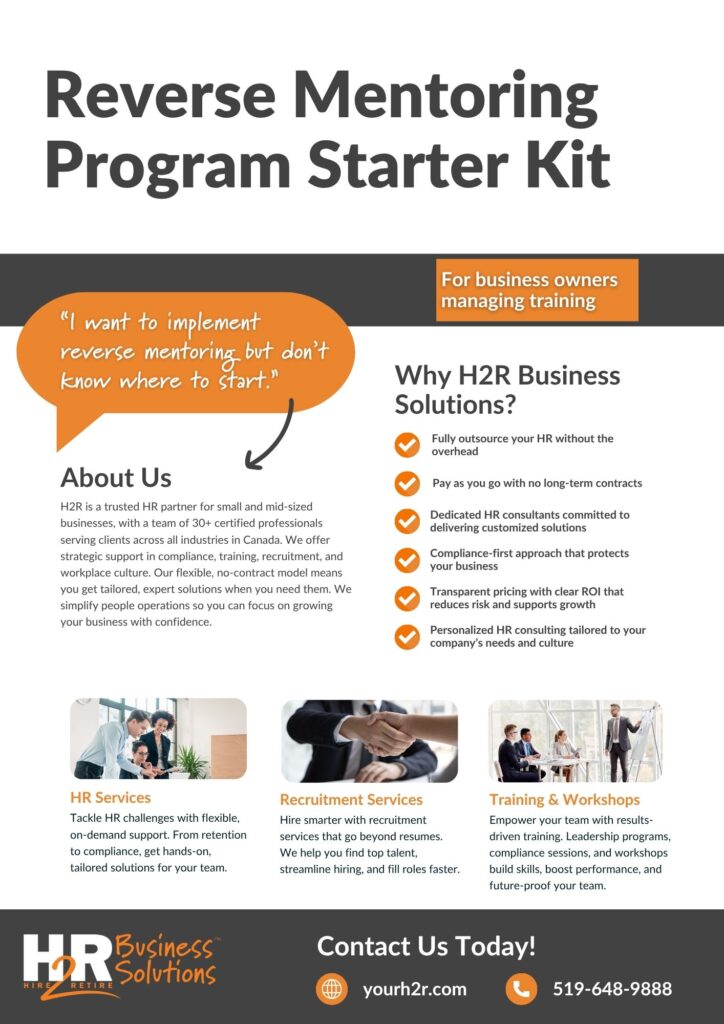
Free Download: Reverse Mentoring Program Starter Kit
Setting up a reverse mentoring program isn’t easy. The concept itself is simple, but the logistics are where most get tripped up: Who do you pair? How long should sessions run? What do you actually say in the kickoff conversation?
We built this Reverse Mentoring Starter Kit to simplify the process. Inside, you’ll get:
- An editable session planner mapped to the six-session framework covered in this guide, so you’re not building a structure from scratch
- A matching worksheet to help you pair mentors and mentees around real fit — not just whoever’s available
- A 90-day rollout checklist covering everything from the opt-in survey to the midpoint check-in to the wrap-up conversation
- Built specifically for teams under 200 employees, so there’s no scaling-down required
We’ve helped dozens of Ontario SMEs implement reverse mentoring in the workplace, this starter kit contains everything you need to do it.
Table of Contents

Download the Free Reverse Mentoring Program Starter Kit Today
Save on training costs & help your multi-generational team learn from each other.
Fill out this form to download the Free Reverse Mentoring Program Starter Kit
If you manage a small or mid-sized business in Ontario, you’ve probably noticed the gap between generations in your workplace.
- Your most experienced people know the business inside out, but they’re not always the ones who understand the tools, platforms, or communication habits modern workplaces are adopting.
- Meanwhile, your junior staff have plenty to offer. They’re freshly educated, they understand the newest technology shaping the industry, but they’re rarely asked to share their knowledge.
This is the gap a reverse mentoring methodology closes. In most workplaces, seniors teach juniors. In reverse mentoring, that role is flipped.
A young employee often has a better understanding of topics like technology, social media, generational perspective, or how younger customers and employees actually think.
This guide walks through how to properly set up a reverse mentoring program at your SME, and why it’s not as easy as you’d think. We’ll cover what tends to go wrong in reverse mentoring, and how to keep it running past month one.
Why Reverse Mentoring Works So Well for SMBs
Larger companies have run reverse mentoring programs for years: General Electric and Procter & Gamble were early adopters, pairing senior executives with younger employees on digital trends.
SMBs tend to assume this is a “big company” initiative because of the structure it implies. It isn’t. If anything, a smaller team should have an easier time running a reverse mentoring program.
Here’s why it tends to work well at smaller organizations specifically:
- Fewer layers means less bureaucracy. You don’t need a formal L&D department to launch this. A spreadsheet, a few willing pairs, and a clear goal is enough to start.
- Relationships are already closer. In a 30-person company, your VP of Operations probably already knows the name of every junior hire. That existing familiarity makes the mentoring conversation less awkward than it would be at a 3,000-person company.
- It surfaces blind spots fast. Leadership at SMBs often wears multiple hats and doesn’t have time to stay current on every platform, tool, or trend. A junior employee who actually uses TikTok for recruiting, or knows why your internal Slack channels have gone quiet, can save weeks of guessing.
- It’s a retention lever that costs almost nothing. Younger employees frequently cite a lack of growth opportunities and a lack of being heard as reasons they leave. Reverse mentoring directly addresses both, without a budget line for new software or a six-figure leadership program.

How to Build Your Own Reverse Mentoring Program: Step-by-Step Guide
Step 1: Define the Purpose Before You Define the Pairs
The single biggest reason reverse mentoring programs fail is that nobody decided what they were actually for. “Bridging generational gaps” is not a clearly defined purpose, you need something more specific.
Examples of clearly defined purposes:
- Help senior leadership understand how Gen Z employees evaluate job offers and benefits
- Improve your management team’s comfort with AI tools used day-to-day (project trackers, scheduling software, generative AI for drafting)
- Give leadership direct insight into how customer-facing staff use social platforms for service and sales
- Build cross-departmental relationships in a company that’s grown too fast for people to know each other anymore
An important note is not to overdo it. Choose one or two purposes to focus on, you can’t solve every generational and technological gap, and that shouldn’t be the goal.
Step 2: Decide Who’s Involved
Not every senior employee is a good fit for being mentored, and not every junior employee wants to mentor a VP. Forcing pairings based purely on org chart logic is a fast way to kill momentum and motivation.
Look for:
- Mentors (junior side): comfortable speaking up, genuinely knowledgeable in the topic area, and not someone who’ll use the sessions to vent about unrelated workplace frustrations
- Mentees (senior side): open to being a beginner again, willing to ask “dumb” questions, and not someone who’ll quietly treat the sessions as optional
An easy way to find willing participants is with an opt-in survey. Ask both groups what they’d want to learn or teach, and what format they’d prefer (in-person, virtual, structured agenda vs. open conversation).
Step 3: Match Thoughtfully, Not Randomly
Most facilitators go straight into random pairings, but chemistry matters. Mismatches are the quickest reason things go wrong.
A few things to consider when matching:
- Match around the stated purpose first, personality second
- Avoid pairing someone with their direct manager — the power dynamic makes honesty harder in both directions
- Mix departments where possible; cross-functional pairs tend to surface more useful insight than two people who already sit three desks apart
Example pairing for a 40-person logistics company:
- Purpose: improve leadership’s understanding of how dispatch software changes are received by frontline staff.
- Pair: a 24-year-old dispatcher (mentor) with the Director of Operations (mentee), who hadn’t used the dispatch app hands-on in over a year.
Step 4: Set a Structure (Even a Loose One)
Open-ended “just chat about it” sessions tend to lose steam by session three. Give pairs a light structure they can adapt.
Here’s a simple six-session starting framework:
| Session | Focus |
|---|---|
| 1 | Introductions, goals, what each person wants out of it. |
| 2 | Mentee shares context — what they currently know and don't know. |
| 3 | Mentor walks through a real example — a tool, a platform, or a workflow. |
| 4 | Mentee tries it hands-on while the mentor coaches. |
| 5 | Discuss how this connects to broader team or business decisions. |
| 6 | Wrap-up: what changed, what's next, and whether the pairing should continue informally. |
Sessions don’t need to be long. Thirty minutes every two weeks is enough for most topics and easier to protect on a calendar than a full hour weekly.
Step 5: Set Expectations With Both Sides — and With Their Managers
This step often ends up getting skipped, but it’s an essential part of maintaining momentum. If a manager doesn’t know their employee has a recurring 30-minute commitment, that meeting is the first thing that gets bumped when a deadline hits.
Setting clear expectations can prevent this and other miscommunications from happening.
Put it in writing:
- Confirm session frequency and rough end date with both participants
- Let managers know the time commitment so it doesn’t compete invisibly with other priorities
- Clarify that mentoring sessions are work time, not a meeting to skip every other month and/or squeeze into lunch breaks
Step 6: Build in a Feedback Loop
A short check-in at the midpoint (around session 3) catches mismatches early, before both people have quietly given up.
Ask participants:
- Is this still useful to both of you?
- Has the focus drifted from what you originally agreed on?
- Do you need a different format or topic?
This is also where you decide if a pairing should be reshuffled. It’s best to swap pairings early on than try to force mismatches.

Reverse Mentoring Gone Wrong: Common Mistakes
Mistake 1: Treating it like a one-off event instead of a relationship
A single “lunch and learn” where a junior employee gives a presentation on social media trends is useful, but it’s not reverse mentoring. The value comes from the ongoing relationship and the trust that builds over several sessions.
Mistake 2: No clear topic, sessions don’t bring value
Without a defined purpose, the actual reverse mentoring sessions are unfocussed, unproductive, and lacking real value. If junior mentors don’t understand what the program is trying to achieve, they can’t effectively contribute to its success or guide meaningful conversations.
Sessions can turn into the junior employee airing grievances about workplace culture, which puts the senior employee in an uncomfortable position and isn’t what either side signed up for.
Mistake 3: Mentors aren’t given any guidance on how to lead a session
Being good at TikTok or comfortable with AI tools doesn’t automatically translate into knowing how to structure a conversation or give useful feedback to someone twenty years their senior. A little coaching goes a long way.
Reverse Mentoring Tips to Get it Right
- Start small. Three to five pairs is plenty for a first round. You’ll learn what works before scaling it across the whole company.
- Train mentors briefly before launch. A 30-minute session on active listening, giving feedback respectfully, and keeping conversations on-topic prevents a lot of early awkwardness.
- Let mentees ask the obvious questions. Part of the value is leadership being willing to look like a beginner. If a senior leader can’t ask “how does this app actually work” without embarrassment, the program won’t go anywhere.
- Document the takeaways, even informally. A short shared doc per pairing — three things learned, one thing to change — turns individual conversations into something the wider business can act on.
- Tie it to something real. Programs that connect to an actual business problem (improving a customer-facing process, modernizing internal communication, understanding a hiring gap) tend to outlast programs framed as a generic culture initiative.
- Revisit and renew, don’t assume it runs forever. Check in after each cycle. Some pairs will want to continue informally; others will be ready to wrap up and free up the mentor for a new pairing.
Frequently Asked Questions
What is reverse mentoring?
Reverse mentoring is a mentoring structure where a less experienced or more junior employee mentors a more senior colleague, usually on a specific topic like technology, social media, or generational perspective, rather than the traditional senior-to-junior direction.
How long should a reverse mentoring program last?
Most successful programs run in defined cycles of three to six months, with sessions every two to four weeks. A fixed end date gives both participants a natural checkpoint to decide whether to continue, adjust the focus, or wrap up.
Should reverse mentors receive training?
Yes, even briefly. A short session on how to structure a conversation, give constructive feedback, and stay on topic helps junior mentors feel more confident leading a session with someone more senior. It also prevents sessions from drifting off course.
What topics are best suited for reverse mentoring?
Technology and digital tools, social media and online platforms, generational perspectives on work and benefits, and how younger or newer employees experience the company’s processes all tend to work well. The best topics are specific enough that the mentor has real, hands-on knowledge to share.
What if my team rejects reverse mentoring?
Resistance is usually about how it’s introduced, not the concept itself. Senior employees may worry it implies they’re behind, and junior employees may feel unqualified to “mentor” someone more senior. Reframing it as a two-way knowledge exchange, rather than a teaching arrangement, and starting with volunteers instead of mandatory pairings, usually resolves this.
How do I measure success in a reverse mentoring program?
Look at both qualitative and practical signals: whether mentees report specific new knowledge or behaviour changes, whether mentors report feeling more engaged or valued, and whether the original business purpose (better tool adoption, improved understanding of a customer segment, stronger cross-departmental relationships) shows measurable movement.
Exit surveys at the end of each cycle are usually enough to capture this without adding administrative overhead.
Enjoyed this article? Share this post!
Follow H2R on Social