
Free HR Compliance Risk Assessment Template for Ontario Businesses
Written by: The H2R Team
Do you know where your HR compliance risks actually are?
Many Ontario businesses assume they’re compliant because they have some policies in place or haven’t had issues yet. In reality, compliance risk isn’t about what’s missing entirely — it’s about what’s outdated, inconsistently applied, or undocumented.
Most businesses don’t know they’re non-compliant until it’s too late, don’t be one of them.
Table of Contents

If you haven’t conducted an HR compliance risk assessment yet, you’re leaving your business’ future to chance.
Get started now by downloading our free compliance risk assessment template!
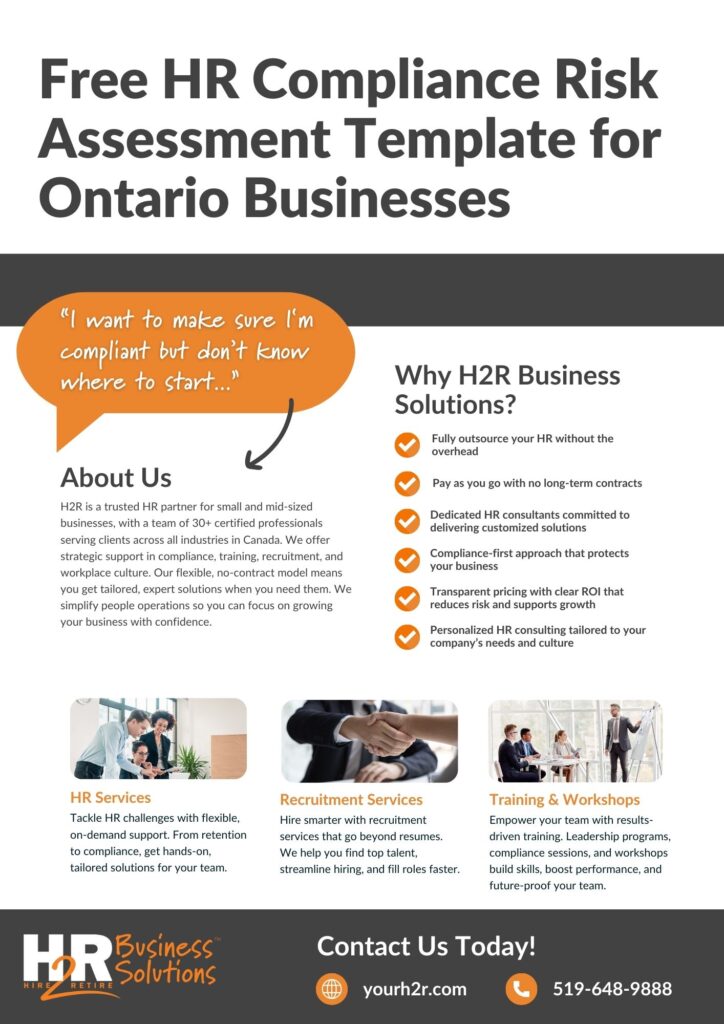
Our Free HR Compliance Risk Assessment Template for Ontario Businesses helps you identify where your organization may be exposed to legal, financial, or operational risk — before problems arise.
Fill out this form to download our HR Compliance Risk Assessment Template!
What Is an HR Compliance Risk Assessment?
An HR compliance risk assessment is a structured review of your organization’s HR practices to determine what’s compliant, what’s partially compliant, and where there’s risk. It is a form of risk management that protects your businesses from serious legal and financial consequences.
How Does a HR Compliance Risk Assessment Work?
Rather than focusing only on whether policies exist, a risk assessment looks at how HR is actually being managed across key areas such as employment standards, health and safety, accessibility, training, and documentation.
A bad HR compliance risk assessment often looks like this: “do we have this mandatory policy? If yes, we’re compliant.”
But it’s not that simple. Compliance is too complex for a simple “yes or no”.
Do I Need an HR Background to Use the HR Compliance Risk Template?
No, anyone can use this template! The template is designed for business owners, managers, and HR leads, no HR or legal background required.
What the Free HR Compliance Risk Assessment Template Covers
The free compliance risk assessment template walks you through the most common areas where Ontario employers face compliance risk, including:
- HR Policies & Documentation: Reviewing whether required policies exist, are up-to-date, and are being applied consistently. You should also assess the way policies are written, including whether the wording is fully compliant, or if it is too complex to understand.
- Employment Standards Compliance: Assessing risk related to hours of work, overtime, vacation, leaves, and termination practices.
- Human Rights & Accommodation: Identifying gaps in accommodation processes, discrimination prevention, and how complaints are handled.
- Health & Safety Practices: Reviewing training, reporting processes, and documentation under occupational health and safety legislation.
- Accessibility Compliance (AODA): Assessing accessibility policies, training, and compliance obligations for Ontario businesses.
- Training & Recordkeeping: Evaluating whether required training is being delivered and properly documented.
HR Compliance Red Flags: How to Identify When Your Business is at Risk
Here are some key indicators that your business is at serious risk of non-compliance:
You’re unsure which HR policies are legally required for your business size or industry
Consequences: You end up missing policies that are legally-required and keep policies that don’t apply to your business and aren’t necessary.
Policies exist but haven’t been updated in years, or don’t reflect current legislation
Consequences: Current policies fail to be consistent with current legislation, making them unethical, unenforceable, and unable to protect you if legal issues happen.
You have no process to ensure you’re up-to-date with current legislation
Consequences: Policies and practices can quickly become out-of-date, even if you intend to keep them up-to-date. Without a standard, repeatable process, internal teams forget to update and have no way of knowing if/when updates have already happened.
You depend on a single person or group for HR knowledge and best practices
Consequences: When the people with the most HR knowledge and internal context leave, your team has no way of adapting and transferring knowledge. Onboarding new HR staff becomes overly complex, consistency goes out the window, and your business needs to fight to survive every transition.
Your HR systems and processes aren’t documented or are documented inconsistently
Consequences: Without documentation, day-to-day HR practices, as well as onboarding, become inconsistent from person-to-person, reducing the effectiveness of your HR team and leaving compliance to chance.
Employee issues are handled differently depending on the manager dealing with them
Consequences: You can’t guarantee whether employee issues are resolved according to standard practices, as each manager treats them differently. Employees, feeling their issues are being treated unfairly, become disengaged, unsatisfied, and lose trust in leadership.
Training is informal or undocumented, especially for health and safety or harassment prevention
Consequences: Training becomes ineffective and employees operate inconsistently across the entire organization, including when it comes to compliance. Without documentation, managers have no guidance when it comes to what information they share and how they prioritize it.
You’re reacting to problems instead of preventing them, such as addressing issues only after complaints arise
Consequences: Rather than protecting your business, your business stays in constant damage control. Real issues feel like inconveniences, employees are reluctant to speak up, and your business is always at risk of a lawsuit or failed compliance audit.
The 3 Most Common HR Compliance Risks in 2026 (and How to Solve Them)
Missing or Outdated Mandatory HR Policies
Ontario employers are required to have specific policies in place. Some required policies include workplace violence and harassment policies, health and safety policies, and accessibility policies.
When what’s required is missing, incomplete, or out of date, businesses expose themselves to fines, orders to comply, and lawsuits. Remember that outdated policies are just as risky as having none at all.
How to Solve It:
- Our 2026 Checklist for Legally Required HR Policies in Ontario can show you which HR policies apply to your business based on your size, location, and operations.
- To ensure policies stay up-to-date, implement a regular review schedule and process to review policies annually. This doesn’t just help you comply with current legislation, it also helps you align policies with workplace realities and changing expectations.
Inconsistent Application of HR Practices
When managers apply rules differently, discrimination claims, grievances, and employee complaints are a serious risk. Inconsistency often happens when there’s no clear guidance, no formal training, or no centralized HR oversight.
How to Solve It:
- Implementing clear procedures for handling performance issues, accommodations, discipline, and complaints will help ensure fairness and reduce legal exposure.
- Managers should also know when to escalate issues and when HR support is required. Some issues should not be handled by a single manager alone.
Accessibility and Accommodation Gaps
AODA compliance is more than just a written policy. Employers must also implement the policy by understanding how to eliminate biases in hiring practices, remove barriers in the workplace, and accommodate customers, clients, and employees with disabilities. Employers also need to understand that accessibility isn’t limited to physical disabilities.
How to Solve It:
- Understand which AODA standards apply to your business based on size and whether you provide goods, services, or employment
- Maintain written accessibility policies for both employees and customers, where required
- Provide consistent training to employees and managers on accessibility requirements, including how to respond to accommodation requests
- Review job postings, onboarding materials, and workplace practices to ensure they don’t create unnecessary barriers
- Update accessibility policies and plans regularly, especially as your workforce or operations change
- Document all accessibility training and accommodations to demonstrate compliance
Enjoyed this article? Share this post!
Follow H2R on Social