
Why Your Onboarding Process Is Failing Half Your Generations (And How to Fix It)
Written by: The H2R Team
Most onboarding programs are still built around one assumption: that everyone learns, communicates, and settles into a new job the same way.
They don’t. A 24-year-old starting their second job out of school and a 55-year-old switching industries after two decades somewhere else are not going to respond to the same onboarding binder, the same half-day orientation, or the same job shadowing approach.
One size fits all sounds efficient, but in practice, it means half your new hires feel unsupported. As an employer, getting the onboarding process right is more important than ever, and sets the tone for all new hires joining your team.
In this blog, we’ll take a practical look at what’s actually breaking down in onboarding right now, and how generational gaps in the workplace make a difference.
Table of Contents

The Problem with Most Onboarding Programs
Most onboarding plans contain a checklist of paperwork and system logins. Other businesses don’t even have an onboarding plan written down at all, they just have a senior employee show the new hires around.
Neither is really an onboarding process, they’re administrative tasks.
Here’s where most employers get onboarding wrong:
- It’s front-loaded and then disappears. Day one is packed with information, but on day fifteen, there’s nothing. New hires are left to figure things out on their own right when they’re starting to take on real work.
- It assumes prior context that doesn’t exist. “Just check the shared drive” means nothing to someone who doesn’t know your folder structure, your shorthand, or who owns what.
- It’s built around one communication style. Usually whatever the person who wrote the onboarding plan prefers, often a lot of reading, a single training session, and minimal follow-up.
- Feedback only happens at the 90-day review. By then, small confusions have either turned into bad habits or the employee has quietly checked out.
None of this is generational on its face. But generational differences make these gaps more visible, because different employees hit different walls.
Understanding Today's Multi-Generational Workforce
Right now, most Canadian workplaces have employees spanning four generations:
| Generation | Roughly Born | Typically Brings |
|---|---|---|
| Baby Boomers | 1946–1964 | Deep institutional knowledge and a preference for direct conversation. |
| Generation X | 1965–1980 | Independence and comfort with both traditional and modern systems. |
| Millennials | 1981–1996 | Collaborative work habits and an expectation of regular feedback. |
| Generation Z | 1997–2012 | Digital fluency and a preference for quick, visual information. |
The table above describes tendencies at a population level. It may not apply to everyone, for example, there are plenty of tech-forward Boomers.
What it does tell you is this: if your onboarding only works for one learning style, it’s statistically going to underserve a chunk of your workforce. It’s a problem with how your onboarding is designed.
Why Generational Differences Matter During Onboarding
Onboarding is where mismatches show up fastest. It’s the first stretch of time an employee spends figuring out how things actually work here.
A few places this plays out in real workplaces:
- How people learn. Some new hires want detailed documentation they can refer back to later. Others prefer learning through conversations and asking questions as they go. If onboarding only supports one approach, some employees will struggle unnecessarily.
- Comfort with technology. Not everyone arrives with the same experience using workplace tools. Assuming new hires can “figure it out” on their own often leads to frustration, mistakes, and slower ramp-up times.
- Feedback preferences. Some employees want regular check-ins and guidance, others prefer more independence. A one-size-fits-all approach can leave people feeling unsupported and micromanaged.
- Building workplace relationships. Some new hires enjoy getting involved with the team right away. Others prefer to settle into their role before focusing on the social side of work. Effective onboarding makes room for both approaches.
- Why it matters: When onboarding doesn’t account for these differences, employees take longer to become productive and are more likely to leave or check out. A more flexible onboarding process can improve engagement, reduce turnover, and help new hires succeed faster.
How to Build an Onboarding Process That Works Across Generations
Step 1: Offer Multiple Learning Formats
Don’t pick one format and hope it works for everyone. Build a small library of options:
- A short written guide for people who want to reference things later
- A 5-10 minute walkthrough video for people who’d rather watch than read
- A live or recorded explanation they can ask follow-up questions about
Most of this only needs to be created once, after which it can be reused. A 10-minute screen recording of “how to submit expenses” can be reused for every new hire going forward, and it solves the problem permanently for that topic.
Step 2: Create a Structured 30-60-90 Day Plan
A 30-60-90 day plan gives new hires a roadmap instead of a single orientation day followed by silence. It also gives managers a structure to actually follow instead of relying on memory.
Weak example: “Get comfortable with the role and team over the first few months.”
Stronger example:
- Days 1-30: Complete system access setup, shadow two client calls, finish compliance training modules, meet 1:1 with each direct team member
- Days 31-60: Independently handle three routine tasks with manager review, present one process observation to the team
- Days 61-90: Own a small project end-to-end, complete first formal check-in on goals and fit
The second version works for every generation because it removes guesswork. It doesn’t assume the employee knows what “getting comfortable” looks like, it tells them clearly what is expected.
Step 3: Pair New Hires with Mentors or Buddies
A formal buddy system gives new hires a low-stakes person to ask questions to, someone who isn’t their manager and isn’t going to be evaluating them.
This change in dynamic is important because it helps the individual feel more comfortable asking questions. They won’t feel as if they’re being assessed or that they’re wasting their manager’s time with endless questions.
A lot of early confusion goes unaddressed simply because the employee doesn’t want to “bother” their manager with small questions.
Step 4: Incorporate Reverse Mentoring Opportunities
Reverse mentoring is a structured learning relationship where a newer employee mentors a more experienced colleague in a specific area of knowledge or expertise.
Whether it’s AI tools, digital workflows, collaboration platforms, social media, or productivity techniques, newer employees can bring practical knowledge that benefits the entire organization. The challenge is creating opportunities for that knowledge to be shared. Reverse mentoring takes advantage of that exact thing.
Bringing reverse mentoring to your workplace involves building a structured knowledge-sharing program that pairs newer employees with more experienced team members. The newer employee contributes fresh ideas, emerging skills, and outside perspectives, while the experienced employee provides business context, organizational insight, and lessons learned from experience.
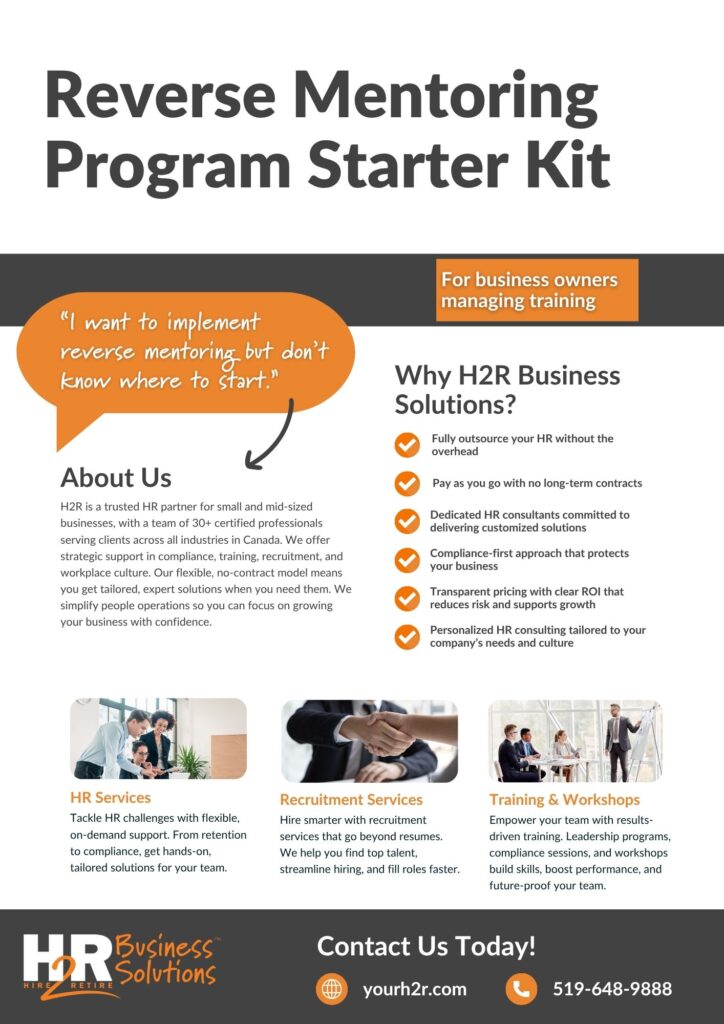
Free Download: Reverse Mentoring Program Starter Kit
Many organizations like the idea of reverse mentoring but struggle to move from concept to implementation. Questions about participant selection, meeting structure, expectations, and accountability can quickly put the program to a halt.
To help, we’ve developed a Reverse Mentoring Program Starter Kit with practical templates, implementation guidance, and discussion frameworks that make it easier to launch and sustain a program. Download it for free!
Fill out this form to download the Free Reverse Mentoring Program Starter Kit
Step 5: Make Feedback Continuous
Newer-to-the-workforce employees often need more explicit confirmation they’re on the right track. More experienced hires usually want fewer check-ins, but still want to know early if something they’re doing isn’t landing the way they expect.
A simple structure that works across the board:
- Week 1 check-in: “What’s unclear so far?”
- Week 2 check-in: “What’s taking longer than it should?”
- Week 4 check-in: “What would make the next 60 days easier?”
These take minutes and prevent the kind of slow disengagement that’s much harder to reverse once it sets in.
Frequently Asked Questions
Do different generations really need different onboarding approaches?
Not entirely different approaches, but different options within the same process. The goal isn’t building four separate onboarding tracks by age, but offering enough flexibility in format, pacing, and feedback that employees with different working styles can all get what they need from the same program.
What is the best onboarding method for a multi-generational workforce?
The most effective programs have multiple formats for delivering information, a structured 30-60-90 day plan, ongoing informal check-ins, and a mentoring structure that lets knowledge flow in both directions.
What role does AI training play in onboarding today?
AI tools are increasingly part of day-to-day workflows, and new hires often arrive with very different comfort levels using them. Some have used AI tools extensively, others have had no exposure at all.
Onboarding that addresses how your team actually uses AI, including expectations around accuracy checks and appropriate use, helps new hires get up to speed faster and reduces the risk of inconsistent or unsafe use early on.
Enjoyed this article? Share this post!
Follow H2R on Social