
How Much Leadership Time Is Wasted on HR Tasks?
Written by: The H2R Team
How much is HR time really costing you?
5 hours a week? 30 hours a month?
Every hour you spend on HR paperwork is an hour you’re not spending with a client, making a product decision, or coaching your team. It’s time you’ll never get back.
And that’s not all. Research consistently shows that moving between different types of work, like moving from management work to HR tasks, slows you down and affects your focus.
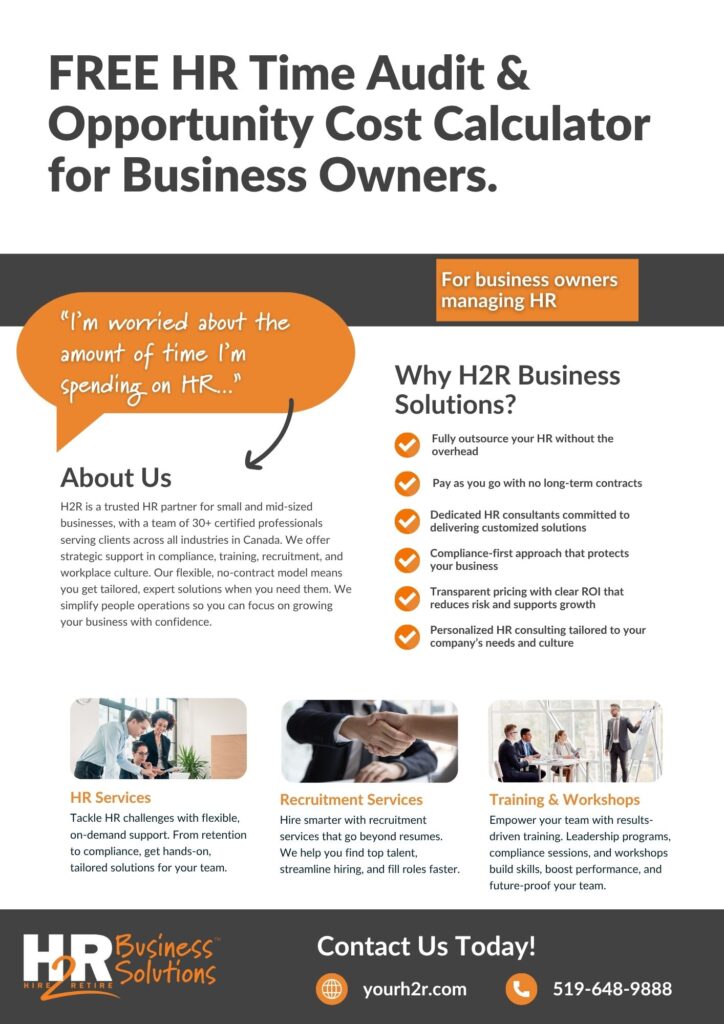
But it’s hard to see the impact when you can’t quantify it. That’s why we’ve developed this FREE HR Time Audit & Opportunity Cost Calculator specifically for business leaders who juggle HR tasks in their day-to-day work.
Find out how much time you’re really spending on HR with our FREE HR Time Audit & Opportunity Cost Calculator. Fill out the form below to download and start using it for free!
Table of Contents

Save Money & Time By Downloading Our HR Time Audit & Opportunity Cost Calculator
Fill out this form to Download the FREE HR Time Audit & Opportunity Cost Calculator
You’re running a small business. That likely means you’re also the owner, the manager, the HR department, and the finance team all at once. It’s a lot, and HR is one of the functions that tends to get the “short end of the stick”.
But in 2026, HR isn’t something that businesses can just overlook anymore. Today’s workforce are hypervigilant, compliance standards are higher than ever, and recruitment is a constant tug-of-war.
There’s a smarter and more affordable way to access senior HR expertise without hiring a full-time HR person. It’s called fractional HR consulting, and it’s growing fast among Canadian small businesses. At H2R Business Solutions, we help Canadian small and mid-sized businesses solve exactly this kind of challenge — providing flexible, on-demand HR support that fits your budget and your stage of growth.
In this article, we’ll break down what fractional HR is, why it matters more than ever in 2026, and how to know if it’s the right move for your business.
Key Takeaways
- Fractional HR gives small businesses access to senior HR expertise without the cost of a full-time hire
- In 2026, employment law is more complex than ever. Fractional HR support acts as a risk management tool to audit existing and emerging HR systems.
- Fractional HR is flexible — you scale it up or down based on what your business needs
- Common small business HR mistakes such as bad hires, missed compliance, and high turnover are largely preventable with fractional HR support
What HR Tasks Are Leaders Still Handling in 2026?
| HR Task | Why It Lands on Leadership | Time Impact |
|---|---|---|
| Onboarding paperwork | No automated process in place | High — forms, follow-ups, manual checks |
| Payroll issues and corrections | Leaders often serve as the final approval | Medium-High — errors need quick fixes |
| Leave and absence approvals | No self-service system available | Medium — frequent, repetitive interruptions |
| Employee policy questions | No centralized FAQ or self-service hub | Medium — repeated daily or weekly |
| Compliance documentation | Legal risk drives leader involvement | High — time-sensitive and detailed |
| Performance management admin | Tied to leadership accountability | Medium — scheduling, forms, follow-up |
| Reporting and data entry | Disconnected systems require manual work | Medium — ongoing and easy to underestimate |
It’s not that it’s inherently bad practice to have leadership involved in these tasks, in some cases, it may even be necessary.
However, there’s no process or system in place to handle them without pulling a senior leader in every single time. That’s where leadership time gets eaten up.
How Much Leadership Time Is Wasted on HR?
CEOs of small and mid-sized businesses can spend up to 46% of their time on HR issues.
Meanwhile, HR professionals themselves report spending 57% of their time on administrative work — with approximately 20% of total HR time going to redundant tasks.
Apply that 20% waste fraction across roles, and here’s what the math looks like*:
| Role | HR Time Share | "Wasted" Fraction (20%) | Hours Lost Per Week |
|---|---|---|---|
| CEO / Business Owner | Up to 46% | ~9.2% of total time | ~3.7 hours/week |
| Middle Manager | ~28% | ~5.6% of total time | ~2.2 hours/week |
| HR Staff Member | ~57% admin | ~11.4% of total time | ~4.6 hours/week |
*based on a 40-hour work week
Keep in mind that these are conservative estimates, some leaders lose considerably more.
Think about what those numbers really mean: nearly half a workday every week, gone to tasks that could be handled differently with the right structure in place.
The Hidden Cost You’re Not Calculating
Here are some costs that aren’t as quantifiable.
- Opportunity Cost: Opportunity cost can appear in a number of ways: the client call that didn’t happen, the growth initiative that never got pushed, the coaching conversation with a high-potential employee that kept getting rescheduled. That’s what low-value HR admin displaces.
- Interruption Cost: Every time an HR question pulls you out of focused work, it costs more than just the time of the task itself. Research shows it can take over 20 minutes to fully re-engage with deep work after an interruption. Multiply that across a week, how much efficiency are you actively losing?
- Compliance Risk: When HR gets handled on the fly with no documented process or record-keeping — things get missed. Your model isn’t just “vulnerable” to mistakes, mistakes are an inevitably.
- Employee Disengagement: Poor HR processes also affect your employees. Slow responses, inconsistent policy application, and rushed onboarding all hurt engagement and retention.
Signs You’re Spending Too Much Time on HR
- You’re answering the same employee questions more than once a week
- Onboarding a new hire takes hours of your personal time to coordinate
- Payroll corrections or leave approvals regularly interrupt your day
- You keep putting off strategic planning because HR tasks keep coming up
- You’re not entirely sure your employment practices are fully compliant
- You haven’t tried to update work policies in over a year
- Your HR documentation lives in email chains, spreadsheets, or your head
- You feel like you’re doing HR by accident, not by design
What Smart Companies Do Differently
- They automate repetitive work. Onboarding forms, time-off requests, payroll validation.etc are all key pieces that can be automated with ease. This automation saves everyone time, not just leadership.
- They give employees self-service tools. When employees can check their pay stubs, submit time-off requests, and find policy answers without looping in a manager, everyone can save more time.
- They work with fractional HR consultants. Rather than hiring too early or overpaying for full-time HR, smart companies bring in fractional HR consultants for strategic HR guidance and compliance expertise. Fractional HR consultants can jump in whenever leaders are over-capacity, needs become more demanding, or an annual review is needed.
- They protect leadership time deliberately. High-value leaders are reserved for decisions, strategy, and coaching. Routine approvals and admin are handled by process instead of a single individual.
How H2R Helps You Get Your Time Back
What we do at H2R Business Solutions is step in as your HR team, your compliance resource, and your people strategy partner — without the cost of hiring full-time HR staff. There are no long-term contracts and no cookie-cutter packages. We build what fits your business.
Here’s what we typically take off a leader’s plate:
- Onboarding and offboarding processes
- Policy development and employee handbooks
- Compliance management under provincial employment law
- Performance management systems
- HR operational support, on demand

How to Reduce Leadership Time Spent on HR: Where to Start
- Run a two-week time audit. Start tracking time spent on every HR-related task you touch and add it up over a 2-week span. This will give you a solid idea of how much time is being spent, what HR work it’s being spent on, and when it makes sense to cut back.
- Sort tasks by value. Which ones genuinely need your judgment? Which ones just need a repeatable process? Are there opportunities to automate?
- Start with quick, easy workflow changes. We usually have our clients start with digitized onboarding forms, an online time-off request system, or a simple FAQ for common policy questions.
- Consolidate your HR tools. If employee information is scattered across email, spreadsheets, and sticky notes, it’s costing you hours every month.
- Block time for strategic work. Protect dedicated time for leadership priorities and route routine HR questions to a defined process or point of contact.
- Outsource what you shouldn’t be doing yourself. If HR isn’t your core job, it probably shouldn’t be taking up this much of your week. A fractional HR partner like H2R can serve as your on-demand HR expertise when you need it — whether you’re over-capacity or just need a better point of contact for employees.
Frequently Asked Questions
What HR tasks most commonly pull leaders away from strategic work?
In our experience, the biggest HR time drains tend to be:
- Onboarding coordination
- Payroll corrections
- Leave and absence approvals
- Employee policy questions
- Compliance documentation.
What's the difference between necessary HR involvement and wasted HR time?
- Necessary HR involvement includes judgment calls, compliance decisions, performance conversations, and people strategy.
- Wasted time includes repetitive approvals, data entry, answering the same questions repeatedly, and manually managing tasks that could be automated or delegated.
How do I know if my business is ready for HR outsourcing or fractional HR support?
If you’re regularly interrupted by HR tasks, unsure about your compliance with Ontario employment law, or simply feel like you’re doing HR by accident rather than by design, you’re likely ready. A free consultation with a fractional HR partner like H2R Business Solutions can help you see where the gaps are and what support would actually look like in practice.
You can also learn more about whether fractional HR is right for you in this article:
Enjoyed this article? Share this post!
Follow H2R on Social