
Can AI Replace HR? Why the Human Element Still Matters in 2026
Written by: The H2R Team
Is your business thinking about AI for HR?
Learn How to Use AI Ethically in HR (Without Risking Trust)
In 2026, more companies are turning to AI to speed up hiring, reduce admin work, and make smarter workforce decisions.
But there’s a growing problem: the more businesses automate HR, the more they risk losing trust, culture, and candidate engagement.
AI can be a powerful tool, but using it the wrong way—especially for HR workflows—can do more harm than good.
The best companies balance both AI and human insights into their HR strategy and execution.
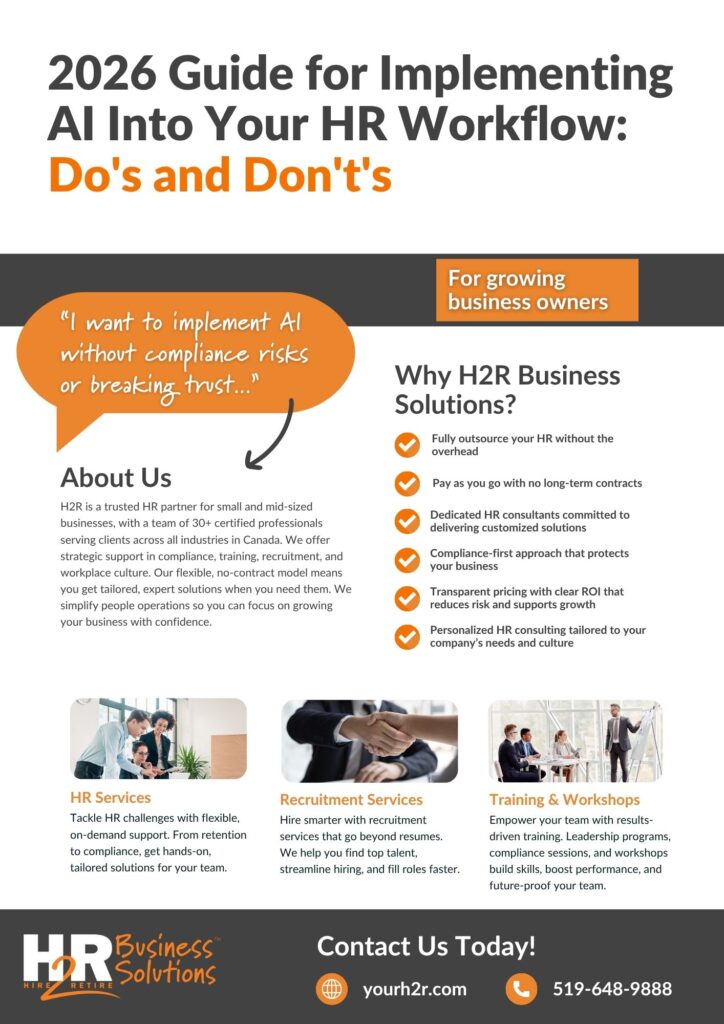
Learning how to master this balance is the hard part, which is why we’ve prepared this 2026 Guide for Implementing AI Into Your HR Workflow. In this guide, we go over the do’s and don’t’s of using AI in HR, so you can understand the risks of implementing it and how to do it the right way.
Table of Contents

Download the 2026 Guide for Implementing AI Into Your HR Workflow for Free!
Fill out this form to download our Free 2026 Guide for Implementing AI Into Your HR Workflow
Can AI Replace HR in 2026?
As a fractional HR leader in Ontario, one question we are getting asked about more often is:
Will HR jobs be replaced by AI?
This is an understandable concern, but I always say the same thing: AI can never replace human HR professionals.
However, AI can help support strategic decision-making and streamline operations by automating day-to-day administrative HR tasks.
I don’t think it’s something our industry should be afraid of, but there are places where it makes more sense than others. This article will cover:
- How AI is being implemented into existing HR workflows in 2026
- How AI can help over-capacity HR teams
- Where AI falls short in HR
- Why HR will always be human-first
- How Fractional HR services can manage complex HR tasks not suitable for AI
What 2026 Statistics Show About AI Use in HR
- 56% of HR professionals have already integrated AI into their operations.
- In contrast, 41% of employees would prefer less AI involvement in HR decisions.
- Employees strongly favor keeping certain responsibilities human-led, with 78% choosing humans for conflict resolution and 76% for disciplinary decisions.
- When it comes to bias, 79% of HR leaders believe AI helps reduce it, while 14% think it actually increases bias, and 7% see no impact.
- AI is expected to have the biggest impact on analytics and data management (58%).
- 47% cite both employee resistance and technical complexity as one of the biggest challenges of adopting AI in HR.
- 53% report technical difficulties with AI use in HR.
The statistics above were sourced from www.paychex.com.

What AI Is Already Doing in HR (2026)
Here is where we see AI already being used in existing HR workflows:
Recruitment and Hiring
AI has changed how Ontario companies find and evaluate talent:
- Automated resume analysis and candidate scoring
- AI-generated job descriptions and interview guides
- Conversational agents handling interview scheduling across time zones
Employee Support and Onboarding
Modern AI systems provide round-the-clock support:
- AI chatbots (custom GPTs) answering benefits and policy questions
- Automated onboarding workflows and task routing
- Personalized learning pathway recommendations
Performance and Development
AI helps organizations develop their workforce:
- Skills-based internal mobility matching
- Continuous performance data analysis
- Automated goal and training suggestions
Administrative Functions
Back-office efficiency has improved dramatically:
- Payroll error detection and compliance reporting
- Multi-step workflow automation (requisitions, offboarding)
- Benefits administration across jurisdictions

How AI Can Help HR Teams (Pros)
AI can help HR teams in many ways, especially when it comes to speed and administrative work. Here are a few of the key advantages that come with using AI for HR:
- AI can help HR teams save time on repetitive tasks. Most AI models are fit to handle high-volume, data-intensive work like initial candidate sourcing, scheduling, and routine policy questions. For the HR team, this frees up time and resources for work that is more strategic and complex.
- AI can achieve higher accuracy and consistency than human HR professionals. For example, automating payroll calculations and compliance reporting reduce human error and ensure consistent application of policies across the organization.
- AI is well-suited for giving routine data insights. It can analyze patterns in employee data to identify retention risks, skills gaps, and development opportunities that might not be obvious at first sight. This is great for teams that often find themselves overlooking regular data tracking in favour of getting more immediate tasks done.
- AI is always available and can’t be limited by capacity. Conversational agents provide immediate responses, can automate multiple tasks at one time, and do work outside of office hours. That said, this may not be the case if you’re paying for a low-cost plan that limits the number of credits you can use at a time.
- AI is naturally and easily scalable. As companies grow, AI systems can handle increased volume without proportionally increasing HR headcount.
Where AI Falls Short in HR (Cons)
Lack of Emotional Intelligence
HR is often a job that depends on empathy and emotional intelligence. Companies can use AI chatbots to answer routine questions, but an AI cannot truly empathize or build trust with employees.
Additionally, AI is not suited for sensitive conversations or topics like harassment investigations or mental health discussions. Using AI in these types of scenarios is an easy way to break trust with internal staff.
Bias Isn’t Eliminated, It’s Just Hidden
There’s a popular misconception going around that AI eliminates bias in hiring and HR decisions.
It’s not accurate to say that AI has no bias in decision-making. You have to remember that AI learns from human data. It’s impossible for it not to inherit bias from that data.
Algorithms trained on historical data often continue systemic bias. AI can perpetuate unfair hiring or promotion decisions unless rigorously audited.
It’s still true that AI can work as a tool to help reduce bias, but relying on the assumption that biased decision-making isn’t possible in AI algorithms introduces a huge risk to your HR strategy. Bias can be weaved into AI’s decision-making at any time, and you may not even know it.
Poor Handling of Complex Employee Issues
AI excels at pattern detection but struggles with situational judgment that requires institutional memory and understanding of unique circumstances.
For example, automated performance evaluations can miss life events, mentor relationships, or role ambiguity that affects fair assessment.
Conflict resolution is also a challenge for AI. AI runs on logic and thrives with direct problem-solving, but conflict resolutions are multi-faceted, emotionally-driven, and often involve compromise. It lacks the important context of long-running team conflict issues and fails to understand the sensitivity needed for emotional grievances.
Culture Building Can’t Be Automated
Company culture is built through everyday interactions, leadership behaviour, and shared experiences. AI can help measure engagement through surveys or sentiment analysis, but it can’t create culture. Humans do that.
Culture building also relies heavily on trust which comes from communication. Using AI for these types of tasks runs the risk of creating a workplace that feels transactional instead of connected.
Why the Human Element Still Matters in HR
- Relationship Building Drives Retention: Strong relationships between HR professionals and employees is a driving factor in engagement, retention, and job security. Employees don’t feel that type of connection with AI.
- Trust and Confidentiality: When workplace conflicts arise, employees need to trust that a real person with decision-making authority is handling their concerns fairly. Complex workplace investigations, disciplinary actions, and confidential employee concerns should not be handled by AI.
- Strategic Decision-Making: AI can assist in strategic decisions when teams feel stuck or out of ideas, but it shouldn’t be making the final decision. Strategic workforce planning involves considering multiple future scenarios and making judgment calls about talent investments that require human insight.
- Candidate Experience: Candidates don’t want to feel like they’re being processed by an automated system. Humans excel at demonstrating authenticity, making candidates feel valued, and evaluating qualitative factors like cultural fit and leadership potential. Additionally, building networks of potential candidates and maintaining relationships with passive talent is something only a human can do.

Keep the Human Element in Your HR with H2R
Can AI replace HR? At H2R Business Solutions, we believe the future of HR lies in thoughtful integration of AI tools with experienced human judgment.
We help our clients implement AI strategically, using automation to handle routine tasks like initial resume screening and administrative record-keeping while ensuring human experts remain involved in all decisions that impact employee careers and company culture.
Our team helps establish the governance frameworks and monitoring systems that make AI implementation successful and low-risk. This includes setting up bias testing protocols, creating clear escalation pathways, and ensuring compliance with Canadian employment law requirements.
If you’re an Ontario company who understands the importance of keeping the human in human resources, our fractional HR services are a great way to balance automated workflows with a people-first philosophy.
- No contracts
- On-demand HR support
- Scalable service options
- A complete team of top HR experts on your side
Frequently Asked Questions about AI Replacing HR
What's the ROI timeline for HR AI implementation?
Most organizations see efficiency gains within 3-6 months for routine tasks, but the full value can be seen in around 12-18 months as teams optimize the human-AI workflow and redirect time to strategic activities.
What are common misconceptions about AI in HR?
- Myth 1: “AI eliminates all bias”
- Reality: AI often continues and hides existing bias from historical data. Human oversight and regular auditing are essential to identify and correct biased outcomes.
- Myth 2: “AI makes HR decisions more objective”
- Reality: AI provides data-driven insights, but the most important HR decisions still require human judgment about context, company culture, and individual circumstances.
- Myth 3: “AI will dramatically reduce HR costs immediately”
- Reality: While AI can reduce transaction costs over time, successful implementation requires investment in training, governance, and monitoring systems.
Enjoyed this article? Share this post!
Follow H2R on Social