
Top Employee Retention Strategies That Work in 2026
Written by: The H2R Team
Every year, Canadian companies save hundreds of dollars in recruitment and onboarding costs by retaining their current staff.
Discover practical, easy-to-implement employee retention strategies built around modern workplace expectations.
Table of Contents

Download these 11 free employee retention strategies and start keeping your best employees for the long-term.
Fill out this form to download our Free Retention Strategy Guide!
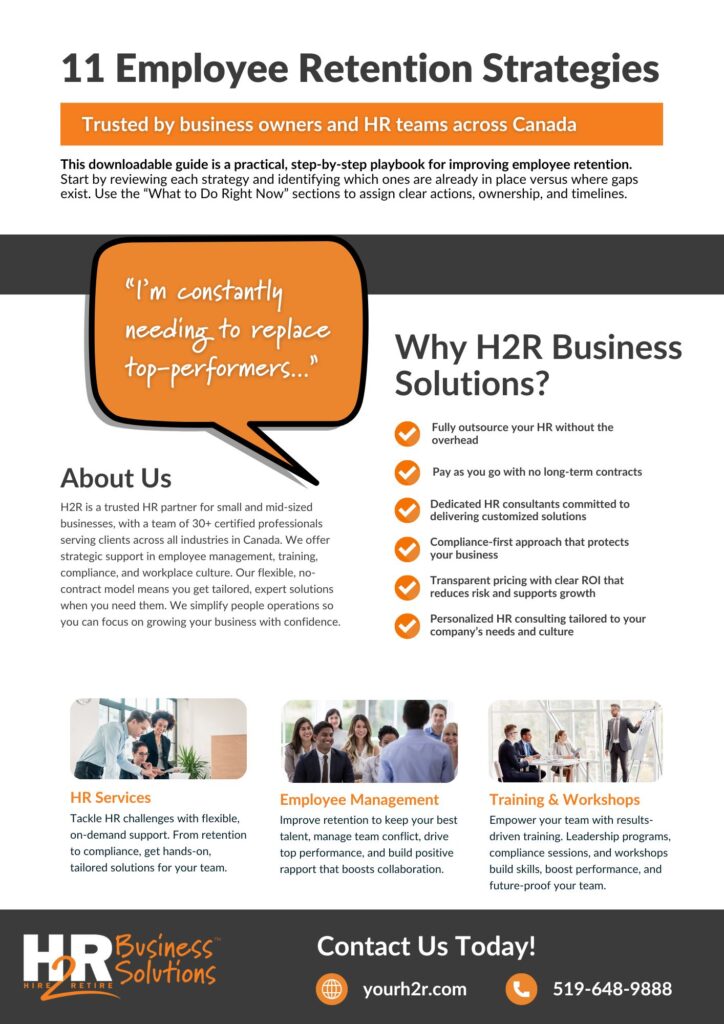
3 Employee Retention Strategies That Work in 2026 (+11 More Available to Download!)
Employers keep their best people by focusing on improving the everyday employee experience and supporting long-term growth. Our proven employee retention strategies reflect what today’s workforce actually values.
Here’s a preview of three employee retention strategies that actually work in 2026. To explore more options, we have 9 more you can download for free.
1. Create Clear, Visible Career Pathways
When employees feel there’s no future for them where they are, they look elsewhere to advance and find new opportunities. Employers that keep top employees long-term are showing them that a future in the organization is attainable and encouraged.
Creating career pathways doesn’t mean you need to immediately start promoting your top performers. Progression can include skill expansion, lateral moves, and leadership development opportunities.
What to Do Right Now
- If you haven’t already, start conducting regular performance reviews.
Use performance reviews as an opportunity to ask about an employee’s career aspirations and discuss how they align with the organization. - Give employees a clear path forward into their desired position with actionable feedback that will help them grow the skills needed.
- Show your commitment to employee growth through internal mentorship programs, job shadowing opportunities, and/or structured skills development training.
2. Use Data to Identify Retention Risks Early
If you’re always finding yourself feeling shocked and blindsided when an employee resigns, then you aren’t effectively using the data you have to determine when employee retention is at risk.
Having the data you need to determine when an employee might leave doesn’t require complex HR systems. Disengagement often shows up first through absenteeism, declining performance, or withdrawal from team activities.
What to Do Right Now
- Track turnover monthly with a simple spreadsheet that tracks voluntary resignations by month, department and manager tied to each exit, and length of service at time of departure.
- If a specific team or manager shows repeated turnover, that indicates a leadership or workload issue.
- Every quarter, ask employees to anonymously rate their experience with questions like: “I understand what’s expected of me at work”, “I feel supported by my manager”, “I see a future for myself here”
- Track scores over time by department. Declines matter more than low scores.
- Intervene with workload reviews, manager coaching, or role adjustments before employees resign.
3. Actively Manage Workload and Prevent Burnout
Consistently high workloads are often overlooked by leadership, but it’s one of the leading causes of burnout, disengagement, low performance, and eventually resignation. The dissatisfaction will only continue to build as pressure goes unchecked.
Retention improves when employees feel supported and protected from overload.
What to Do Right Now
- Review workloads and capacity regularly
- Redistribute tasks when teams are stretched
- Encourage employees to take time off when needed
- Watch for signs of burnout and act early
- Ask employees about their workload regularly and encourage them to speak out when they feel overwhelmed
How to Calculate Your Own Employee Retention Rate
Understanding how many employees stay or leave gives you insight into how big of a problem retention really is. A better retention rate shows a need for small, targeted adjustments, while a lower retention rate demands a completely new, multi-layered strategy.
Here’s the formula you use to calculate your own employee retention rate:
Employee Retention Rate (%) = (Number of employees who remained after set time period ÷ Number of employees at the start of that period) × 100
For example, if you started the year with 50 employees and 45 remained at the end of the year, your retention rate would be 90%. (45 ÷ 50 x 100 = 90)
Here’s how to calculate employee retention in a simple step-by-step format:
- Choose a period of time.
- (Note: We recommend a minimum 1-year timespan for the best results)
- Find out the number of employees you had at the start of that period, these will be labelled “starting employees”.
- Based on the “starting employees”, add up the remaining employees you have at the end of the timespan, these will be labelled “final employees”.
- (Note: Only include the employees you started with that are still working in your company, do not include any new hires you’ve had since the start of that time period)
- Take the amount of “final employees” and divide it by the number of “starting employees”.
- Multiply the number you get by 100.
- The total you get is your employee retention rate.
What Employee Retention Rate is Considered Good?
A “good” employee retention rate depends on your industry, workforce size, and role type. For example, retail is known for extremely high turnover, which lowers the bar for what is considered a good retention rate in that industry.
Regardless, here are some general employee retention benchmarks that may be helpful:
- 90% or higher is considered strong
- 80-89% signals moderate risk
- Below 80% indicates deeper workplace issues
We recommend striving for 90% or above.
Why Employee Retention Matters in 2026
Labour shortages, rising recruitment costs, and increased employee expectations are making employee retention more important than ever in 2026. It’s more than just an HR issue, it’s what helps your business survive.
Replacing staff is harder than ever, especially in highly-specialized roles. The best solution is keeping the staff you already have.
Along with being expensive and time-consuming, high turnover also impacts:
- Team productivity and morale
- Customer experience and service quality
- Knowledge retention and training costs
- Leadership time spent hiring instead of leading
Employers that prioritize retention gain stability, stronger teams, and a competitive advantage in a tight labour market. Having the right employee retention strategies on your side is what gives your business a competitive edge.
What Today’s Employees Expect from the Workplace in 2026
Something many employers don’t understand is how much employee expectations are changing. Without understanding what employees want, you run the risk of losing them to an employer who does understand and will give them exactly what they need.
In 2026, the workforce cares most about:
- Fair pay and transparency — Employees don’t see fair pay and transparency as a benefit anymore, it’s the standard. They’re learning to ask important questions about their pay, and how to identify signs of pay disparity.
- Clear growth and development opportunities — Employees are seeking a place of work where they can see themselves growing long-term. If they don’t see a future, or they don’t think you’re invested in their future, they’ll go elsewhere.
- Reasonable workloads and work-life balance — Employees expect manageable workloads because chronic overwork is no longer viewed as a badge of commitment—it’s viewed as poor management.
- Flexibility that reflects real life — Caregiving responsibilities, mental health, commuting, and personal commitments all influence how employees work best. Flexibility signals trust and respect, two key drivers of long-term retention.
- Benefits that include insurance for mental health support — Employees have begun to highly prioritize their mental wellness, especially at work. Their mental health also influences how they perform day-to-day.
- A workplace where contributions are valued — Feeling invisible leads to disengagement. Employees are far more likely to stay when they feel their work matters and their contributions are acknowledged in meaningful ways.
Frequently Asked Questions
At H2R, we’ve helped dozens of Canadian organizations boost retention with our personalized employee retention strategies and programs. We take a fractional HR approach to our employee retention consulting services, allowing you to benefit from our team’s expert insight flexibly and according to your budget.
While our headquarters is in Kitchener-Waterloo, we work with companies all across Canada remotely and in-person.
Ask us about how we can bring real, scalable results to your organization!
Here’s a quick and straightforward step-by-step guide to creating an employee recognition program:
- Decide what behaviours you want to reinforce: Recognition should clearly reinforce what “doing well” looks like.
- Make recognition timely and frequent: Regular, smaller moments of recognition are more effective than infrequent awards.
- Train managers to recognize consistently: Consistency is important. Ensure managers know how to give specific, fair, and meaningful recognition.
- Show recognition in multiple ways: What matters to each employee is different, and how you recognize them should reflect that. Offer a mix of public, private, peer-to-peer, and reward-based recognition so employees feel acknowledged in ways that matter to them.
- Keep recognition fair and transparent: Set clear criteria and track who is being recognized to avoid bias or over-concentration on the same employees. Employees who aren’t recognized as much can start losing trust and build resentment.
- Connect recognition to growth opportunities: Use recognition to highlight readiness for new responsibilities, development opportunities, or leadership potential.
Measure impact and adjust: Monitor engagement feedback, participation, and retention trends to ensure the program is working and adjust whenever necessary.
Employee retention is managed by designing the employee experience on purpose, not reacting when people resign. In practice, it means putting systems in place that reduce disengagement long before someone starts job hunting.
It starts with:
- Measuring retention before it becomes a problem
- Addressing the biggest drivers of turnover
- Training managers on how to retain employees
- Building growth into the employee lifecycle
- Protecting employees from burnout
- Recognizing contributions consistently
- Communicating clearly and transparently
Enjoyed this article? Share this post!
Follow H2R on Social