
Do you have all of Alberta’s legally-required HR Policies?
Find out what workplace policies are missing right now with our FREE compliance checklist!
Compliance is something we see Alberta businesses struggle with all the time. Employment law is always changing, and business owners can’t keep up.
Businesses who face repeated compliance issues could be fined anywhere between $10,000-$1,000,000. Don’t leave your business open to government audits, fines, or lawsuits!
If you’ve ever questioned whether your business is fully compliant with Alberta employment law — specifically whether legally-required policies are in place — download our Legally Required HR Policy Checklist for Alberta Businesses.
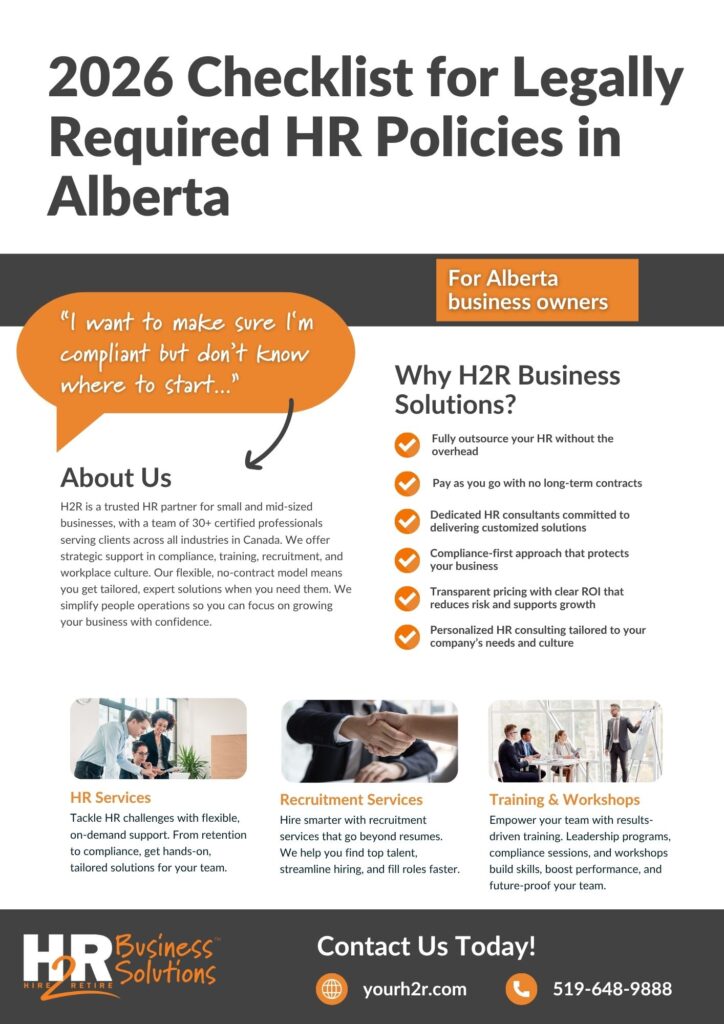
Fill out the form to the left to download our Free Alberta HR Compliance Checklist!
Alberta Regulations That Shape Mandatory HR Policies
Mandatory HR policies in Alberta are guided by several key pieces of legislation:
- The Employment Standards Code
- The Occupational Health and Safety Act
- The Alberta Human Rights Act
- The Personal Information Protection Act
Several of these acts require employers to formalize certain practices into written policies or programs (usually depending on company size).
However, it’s important to keep in mind that not every legal requirement in Alberta explicitly calls for a written policy—but many employers choose to create one anyway. For example:
- Bullying & Cyberbullying Policy
- Hours of Work & Work Schedule Policy
- Maternity & Parental Leave Policy
- Termination of Employment Policy
- Compassionate Care Policy
- Child Death or Disappearance Leave Policy
- Personal & Sick Leave Policy
- Family Violence Leave Policy
- Bereavement Leave Policy
- Court & Jury Duty Leave Policy
- Military Reservist Leave Policy
- Children in the Workplace Policy
None of these policies are legally-required in most work environments.
Employers will implement written policies, even when it’s not required, to demonstrate compliance and accountability.
Putting these requirements into clear, written policies helps:
- Ensure consistency in how rules are applied
- Provide documentation if a dispute arises
- Demonstrate compliance during inspections or investigations
- Reduce reliance on individual managers’ judgment
Today, we will be covering all the legally-required HR policies Alberta employers need. However, we do encourage implementing other non-required policies when it makes sense to the smooth operation of your business, even if not technically required by Alberta law.
Every Legally Required HR Policy in Alberta
General Occupational Health and Safety Policy
Under the Occupational Health and Safety Act, many employers must establish a formal health and safety program along with a written General Occupational Health and Safety Policy. The Occupational Health and Safety Act was created to help protect employees from workplace injuries, illnesses, and fatalities.
All employers must ensure they are providing a safe workplace, regardless of size.
The General Occupational Health and Safety Policy outlines the employers’ duty to safeguard employee wellbeing, including training employees on how to work safely, and identifying and removing workplace hazards wherever possible.
A written OHS policy will outline:
- Employer responsibilities
- Worker responsibilities
- Commitment to eliminating hazards
General Occupational Health and Safety Policy FAQ
How often should an OHS policy be reviewed?
An OHS policy should be reviewed regularly (annually or semi-annually) and whenever workplace conditions change, such as new equipment, processes, or roles.
What’s the difference between an OHS policy and an OHS program?
A policy outlines your commitment and responsibilities, while a program includes detailed procedures, hazard assessments, and training processes.
Reasonable Accommodations Policy
The Alberta Human Rights Act requires employers to accommodate employees up to the point of undue hardship. This regulation helps protect equal opportunity in the hiring process and throughout employment.
The reasonable accommodations policy informs employees and job candidates of their rights while demonstrating compliance as an equal opportunity employer.
Under this policy, employers are expected to reduce or remove barriers related to protected grounds such as disability, religion, or family status. This may involve modifying workplace policies, adjusting job duties, or making changes to the work environment to ensure individuals can fully participate in the workplace.
A formal reasonable accommodations policy helps ensure:
- Consistent handling of accommodation requests
- Compliance with protected grounds (disability, religion, etc.)
- Proper documentation of decisions
Reasonable Accommodations Policy FAQ
What does “undue hardship” mean in Alberta?
Under the Alberta Human Rights Act, undue hardship refers to situations where accommodation would cause significant difficulty or expense, considering factors like cost, health, and safety.
Do I need to accommodate every request?
No, you don’t need to accommodate every accommodation request you receive. However, you must make a genuine effort to accommodate up to the point of undue hardship and be able to demonstrate that effort.
What are considered protected grounds for reasonable accommodations?
Protected grounds for reasonable accommodations include things like disability, religion, gender, family status, and age.
Workplace Violence & Harassment Policy
A workplace violence and harassment policy is a key requirement under Alberta’s Occupational Health and Safety legislation. It is considered a type of workplace hazard.
Employers should be identifying any workplace hazards (including violence and harassment risks) proactively via a hazard assessment. Once workplace hazards are identified, preventative measures need to be put in place.
Along with having a written harassment and violence prevention policy, Employers must:
- Conduct hazard assessments related to violence
- Implement reporting and investigation procedures
- Develop, implement, update, and regularly review a violence and harassment prevention plan (in collaboration with employees)
- Violence and harassment prevention training for employees
- Support employees who have been affected by violence or harassment in the workplace
Failure to have this policy in place is one of the most common compliance gaps identified during inspections.
Workplace Violence & Harassment Policy FAQ
Is a workplace harassment policy mandatory in Alberta?
Yes. Under the Occupational Health and Safety Act, employers must have a written violence and harassment prevention policy and plan.
What counts as workplace harassment or violence?
Workplace violence or harassment includes bullying, threats, verbal abuse, physical force, or any behaviour that could cause harm.
What should I do if a complaint is made?
If a harassment complaint is made, you must investigate promptly and fairly, document findings, and take appropriate corrective action.
Equal Pay for Similar Work Policy
The Employment Standards Code includes provisions around equal pay for employees performing substantially similar work.
A policy helps ensure:
- Pay decisions are based on objective factors
- Protection against gender-based wage discrimination
- Clear internal compensation practices
Employers can be sued for wage discrimination or audited by the Alberta government if a complaint is received. Non-compliance may result in hefty fines.
Equal Pay for Similar Work Policy FAQ
Are there exceptions to equal pay rules?
Yes, there are some exceptions to equal pay rules.
Differences in pay may be acceptable if the difference is based on:
- Experience
- Seniority
- Merit
- Productivity
If the salary disparity can’t be explained through the above reasoning, it could be considered wage discrimination.
Can employees file complaints about unequal pay?
Yes, employees can file complaints about unequal pay with Alberta Employment Standards, which may trigger an audit or investigation.
Personal Privacy in the Workplace Policy
Under the Personal Information Protection Act, employers must manage employee personal information responsibly. Employees have a right to privacy at work when they’re in the workplace or using employer-provided technology.
The Personal Privacy in the Workplace Policy protects an employee’s right to privacy and describes how and when an employer will collect, use, and disclose employee information.
A privacy policy should outline:
- What employee data is collected
- How it is used and stored
- Who it is shared with
- Employee rights regarding their information
This is especially important for businesses handling sensitive HR records or using digital systems.
Personal Privacy in the Workplace Policy FAQ
What kind of employee information needs to be protected?
Employers need to protect sensitive employee data, such as:
- Personal contact details
- SIN and payroll information
- Performance records
- Health-related information
Do employees need to consent to data collection?
In most cases, yes. Employers must obtain meaningful consent for collecting, using, or disclosing personal information to be compliant. To solve this, a consent form is often given during the onboarding process.
What is considered mishandling employee data?
Mishandling employee data refers to any situation where personal information is collected, used, stored, or shared improperly under the Personal Information Protection Act.
Common examples include:
- Collecting more information than necessary for employment purposes
- Using employee data for reasons it wasn’t originally intended for
- Failing to obtain proper consent when required
- Sharing personal information without authorization
- Not properly securing sensitive data (e.g., unsecured files or systems)
- Keeping employee information longer than necessary
Need Help Getting Compliant? H2R Can Help
Understanding Alberta’s HR requirements is one thing—putting the right policies in place (and keeping them up to date) is another.
That’s where H2R comes in.
We work with Alberta businesses to build, review, and maintain fully compliant HR policies aligned with legislation like the Employment Standards Code, Occupational Health and Safety Act, Alberta Human Rights Act, and Personal Information Protection Act.
What H2R Helps You Do
- Develop custom HR policies tailored to your business
- Identify and fix compliance gaps before they become risks
- Stay up to date with changing Alberta employment laws
- Prepare for audits, inspections, or employee complaints
- Save leadership time by outsourcing complex HR work
Whether you’re starting from scratch or cleaning up existing policies, we make sure your business is protected, compliant, and built to scale.
Don’t wait for a complaint or inspection — Get compliant before it becomes a problem.

Enjoyed this article? Share this post!
Follow H2R on Social